Unusual and exotic trees – The wild service tree.
by The blog at woodlands.co.uk, 5 May, 2023, 3 comments
The Wild Service Tree is a native British species. Nowadays, the tree is quite rare and can be an indicator of ancient woodland. The wild service tree or chequers tree (Sorbus torminalis) is a member of the Rose family (Rosaceae). The term torminalis is botanical latin meaning “of or belonging to the gripes, good against the colic”, because the fruits were (at one time) used as a remedy for the colic. It is a tree native to England and Wales but not to Scotland or Ireland. Within those two home nations its distribution is patchy; it is not a common tree. However, it is widely distributed across Europe (notably France and Germany).
The tree is light-demanding species and it suffers if the canopy closes in, so tends to favour the woodland margins, coppiced areas with open and sunny conditions and hedgerows. It does not ‘like’ water logged conditions, nor dry sandy soils. Trials in Sweden, Norway and Denmark indicate the good growth is achieved soils with a silt content of just under 14%, and it can tolerate a pH range from acid through neutral to slightly alkaline.
The tree can grown to a height of 20 to 30 metres, if the conditions are right - and the growth can be fast. Young trees can grow at a rate of one metre a year. It sends down quite deep roots and develops strong laterals (which may extend beyond the diameter of the crown). This means that they are ‘windfirm’ and relatively drought tolerant. The leaves bear some similarity to those of maple. In Spring, the tree produces bunches of creamy white flowers, which provide pollen and nectar for insects. The flowers when fertilised produce brown berries. Like Medlars, these may be bletted - allowed to become over-ripe and have been used to make jams, drinks.
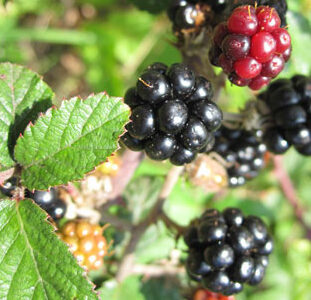
However, many of the fruits fall to the ground where they may be eaten by birds or small mammals. If eaten by birds, then the seeds may be dispersed over a wide area but natural regeneration from seeds is uncommon (though suckering from roots is a possibility). Young plants / saplings may be targeted by voles and mice, they are also sensitive to competition (especially from brambles).
The tree is not grown for timber production in the UK, but abroad the timber is valued as one of the hardest, native European woods. The colour is yellow to light red, though old trees can have a deeper colour. Because of its hardness it was used in the past to make mill cogs, mangle wheels, parts in textile mills and wine presses. Now, the wood is used in furniture making and for wind instruments (flutes, recorders, bag pipes). Wild service trees, grown for timber, are ‘raised’ in ‘coppice with standards”, where the service trees are the standards.
Thanks to Ruth for images.