Woodlands.co.uk

Blog - saplings

spruce woodland

With a little help from my friends ……

by The blog at woodlands.co.uk, 6 June, 2025, 0 comments

Plantations are generally monocultures of economically important tree species, trees that are valued for their timber and rapid growth.  Compared to natural woodland, biodiversity is lower in monocultures. They are less resilient to extreme climatic events, attack by pests and/or disease and offer fewer ecosystems services.  Adding different trees into the mix of species can result in an increase in biomass (timber) production and resilience. Since the 1930’s, a ‘nursing mixture’ of Pines and Sitka Spruce has been used to establish Sitka forest in nutrient-poor soils (without the use of fertilisers or herbicides).  Quite how the pines benefited the growth of the Spruce was not known. One possible ‘mechanism’ is plant soil feedback [PSF], where plants change the nutrient make-up and/or the  bacterial and fungal community of the soil.  These changes then benefit the subsequent growth of seedlings / saplings.  Important in this respect are the fungi that can establish symbiotic / mycorrhizal associations with plant roots.  Ectomycorrhizae (ECM) exist mainly as an external coating on the roots, with some of the hyphae penetrating into the root tissue. Ectomycorrhizae are often associated with woody tree species, particularly conifers. There are a number of parts to a mycorrhizal association with trees: The Hartig net, this is the fungal hyphae that penetrate the roots of the tree, and make contact with the root cells, allowing for the exchange of carbon compounds, mineral nutrients, and water. The Mantle is the sheath of hyphae that covers the tree roots.  It is a more substantive structure than the Hartig net.  The fungal sheath probably offers some protection to the delicate root tips from pathogens and pests.   The Extra-radical hyphae. These grow out from the mantle into the soil. They may spread a significant distance from the actual roots, increasing the surface area for the absorption of water and minerals.  The Fruiting bodies.  These are the reproductive structures of the fungus and are visible above ground. Now some evidence is accumulating about how nursery mixtures / species have their effect.  Last year, researchers at Manchester University looked at the nursing effect of pine and silver birch on Sitka Spruce.   They collected soil from Cannock Chase, where these tree species co-existed.  The soil was sieved and some sand added and then placed in pots. Four groups of pots were created Pots with pine seedlings Pots with Spruce seedlings Pots with silver birch seedlings Pots with all three types of seedlings Pot Treatment Species grown in the conditioned soil Pine conditioned soil  Pine Spruce Birch Spruce conditioned soil  Pine Spruce Birch Birch conditioned soil  Pine  Spruce Birch Pine, Spruce & Birch conditioned soil  Pine Spruce Birch All the pots were placed in a greenhouse and the seedlings allowed to grow on for 34 weeks.  This allowed the growing seedlings to ‘condition’ the soil.  At the end of this time, the seedlings were removed and soil sieved and placed in fresh pots.   The four ‘types’ of ‘conditioned’ soil were then used to grow on newly germinated seeds of the three tree species.   One seedling was grown per pot, and the pots grown on for 24 weeks in the greenhouse again.   At the end of the 24 weeks, the seedlings from each pot were harvested and carefully examined.  For each, many features were recorded Root length Branching intensity Root tissue density Total root length dry weight /mass recorded Ectomycorrhizal colonisation (microscopic analysis) Specific leaf area VIII.Leaf dry matter Photosynthetic rate The soil was also subjected to detailed analysis (e.g : pH, nitrates, microbial enzymes etc). The results showed that  The Spruce seedlings grew best in the soil that had been previously ‘conditioned’ with Pine growing in it. The Spruce fared less well in the previously Spruce ‘conditioned’ soil The increased growth was associated with greater root colonisation by mycorrhizae. Longer term increased growth in the silver birch ‘conditioned’ soil might be associated with increased availability of soil nitrates It would seem that Pines facilitate the growth of the Spruce through the enhanced establishment of symbiotic, mycorrhizal connections.  These connections allow saplings to access vital mineral nutrients such as phosphate.  This study therefore goes some way to explaining the nursing effect of mixed species planting. Full details of this work may be accessed here :  https://besjournals.onlinelibrary.wiley.com/doi/10.1111/1365-2664.14848
Deer in woodlands

Deer in woodlands

by The blog at woodlands.co.uk, 22 June, 2024, 3 comments

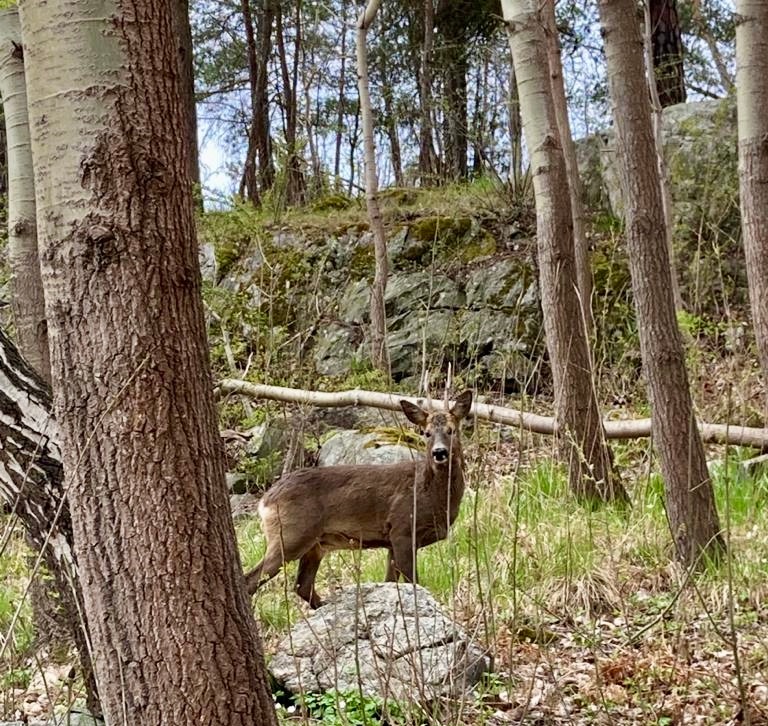
Woodland covers some 1,000 hectares of the Ashdown Forest, that is roughly 40% of its area. Much of the woodland is relatively young. However, the forest’s capacity for regeneration / renewal is being damaged by overgrazing.  Local deer populations have grown and now represent a problem. Deer browse / graze on vegetation, shoots, flower buds and foliage are stripped off plants.  Young saplings are damaged and bark is eaten, especially when food is scarce.  Consequently, tree and shrub regeneration is limited.  Other species are affected by the feeding of the deer, either through loss of niches or food.  Among those at risk are small mammals and certain butterfly species. [caption id="attachment_34368" align="aligncenter" width="650"] deer damage[/caption] Damage is found in woodlands in many parts of the country, as deer populations have increased in recent times. In the 1970s, the deer population was estimated to be around 450,000 as compared to today’s estimates of over 2 million.  The National Forest Inventory highlighted that "40 percent of British forests have ‘unfavourable’ levels herbivore damage, which limits the survival of young trees and threatens biodiversity".  Apart from deer damage, there is damage by the grey squirrel populations. Deer browsing can : Prevent natural regeneration Affect biodiversity Affect woodland resilience Reduce food availability to the herd which can lead to starvation / loss of condition Deer are also hosts to ticks.  The ticks may be infected with Borrelia burgdorferi  bacteria and transmit them to humans, resulting in Lyme disease. Deer  also contribute to collisions with motor vehicles; more than 450 deer were hit by vehicles on Hampshire roads last year .  In Scotland,  government agency figures indicate that deer vehicle collisions  [DVCs] have almost doubled between 2008 and 2020.   Sadly, people are injured or killed in DVCs, and the repair cost to vehicles runs into millions. The solution to the ‘problem’ is not clear cut. Culling [the selective killing of animals] to control deer populations is one way in which numbers can be reduced, and the damage to woodland mitigated.  However, this approach has been met with opposition by many, including animal rights organisations.  There is the argument that whilst a reduction in deer numbers might fix some problems in the short term, the subsequent increase in plant growth and food availability might lead to increased breeding by the remaining deer and numbers would then increase again.  Also, unsuccessful or inaccurate shooting leads to animal suffering, mutilation and / or a lingering death.   Some might advocate rewilding and the introduction of apex predators (such as the wolf, lynx, wild cats*) as a means of reducing numbers but that might raise other problems! Deer have been 'part and parcel' of woodlands since mediaeval times, when the forests were used for hunting. In the Ashdown Forest, the number of red deer declined during the C17th,  and poaching was a factor in their decline. Fallow deer numbers also declined. [Fallow deer were introduced to England by the Normans around 1100 AD.]  The deer population roaming the forest has increased significantly in the recent decades, and now there are the relatively recently introduced species, muntjac and sika deer.   There are six species of deer in UK woodlands – the two native species, the red deer and roe deer and fallow, muntjac, sika and chinese water deer make up the four non-native species. The problem of over grazing is not unique to the Ashdown forest. For example, deer numbers in Scotland have doubled in recent years to almost a million since 1990.   Finding sustainable (and humane) solutions to the large numbers of deer is difficult. * Wildcats were once widespread in Britain, but by the end of the 18th century, they were to be found only in the northern regions. [caption id="attachment_34415" align="aligncenter" width="700"] Remnants of birch woodland near Loch Muick are subject to browsing by red deer (especially in the winter), so temporary fences have been put in place to allow for regeneration.[/caption]
tree planting

Do I need stakes for planting in new woodlands? If so, what sort of stakes are best?

by Angus, 1 February, 2024, 1 comments

A recent article in the New Scientist suggests that staking newly planted trees may be pointless for trees that are planted in gardens and parks.  James Wong argues that stakes are often not needed because trees have a natural tendency to grow straight and vertical. Indeed, staking may cause damage because the tie that connects the post and the tree can cut into the tree.  Also the tie-up to the stake creates a weak point where a sapling can snap in high winds. Even if it doesn’t snap, it develops an unnaturally thick trunk at that point to stop it from breaking. Despite this, you might still want to use a stake in a garden or park for reasons unrelated to the growth of the tree - to avoid it being run over by a lawn mower or accidentally walked into. For forestry planting, using stakes is a very different matter. Stakes are easy to spot and help forestry contractors to find their new trees for weeding and for “beating up” - the odd phrase used by foresters to refer to replanting where trees have died. Using stakes can also help make the trees grow straight which is important for producing top-quality timber. However, the most important function of tree stakes in most new woodland planting is to keep tree guards vertical and securely in position. Most stakes for tree planting use treated softwood and are sawn, but there is a case for using longer-lasting sweet chestnut pales made by splitting. Such stakes are readily and cheaply available from suppliers in East Sussex and Kent. These stakes are strong and easier to bang into hard, stony ground. As well as being long-lasting, sweet chestnut does not need treating so for those using biodegradable tree guards and wanting to “leave no trace”, these may be the best stakes for new planting. Using untreated stakes like this avoids putting extra chemicals into the environment. Another option, often used for new planting of hedgerow trees, is using bamboo canes to hold the saplings and their guards, usually very light spiral guards. Canes as stakes have the added advantage that they are light and easy to transport: when you are planting any new trees there is lots of material to move around the site - guards, young trees, stakes and spades. getting ready for some serious planting  
Trees and the vagaries of climate.

Trees and the vagaries of climate.

by The blog at woodlands.co.uk, 20 October, 2023, 0 comments

During a drought, the trees in a woodland or forest become 'stressed' and may die.  The  reason for their death is not immediately obvious (beyond lack of water), and  it is not possible to ‘transplant’ a mature tree and its complete root system to a lab for detailed investigations.  However, recently, researchers at the University of Innsbruck have taken ‘the lab’ to a set of mature pine and pine trees. The trees were fitted with rugged and waterproof ultra-sound detectors.  Some of the trees had their canopies covered by a ‘roof’ so that the summer rain was denied to the trees, and they essentially experienced a ‘drought’.   Drought stressed trees produce ultrasound ‘clicks’ (faint acoustic waves that bounce off of air bubbles) that can be picked up by the detectors.  Air bubbles or emboli form in the vascular system of the trees when they are struggling for water.  Water is drawn up the xylem vessels by the evaporation of water (via the stomata) from the leaves, there is a continuous column of water.  When the column of water breaks, bubbles form with the xylem vessels and the transport of water to the leaves is reduced.  If the flow of water is substantially reduced the tree will die. The sound detectors found that the spruces produced more clicks than the beeches when water stressed, suggesting more emboli were formed within their xylem tissues.  It may be that the beeches were able to access the deeper reserves of water in the soil, whereas the spruces had a shallower root system. Trees can, of course, reduce water loss from their leaves by closing down their stomates.  But when their stomates are closed, they cannot take in carbon dioxide for photosynthesis and make the sugars / starch that they need for their metabolism.  At the end of the experiment, the trees that experienced ‘drought’ were drenched with water and most recovered well, and their rates of photosynthesis caught up with the ‘control’ groups of trees (those with summer rain).  However, the spruces’ water reserves were somewhat depleted; this was determined by measuring the resistance the tissues offered to an electrical current. The ability to withstand / recover from drought could over time affect the make up of woodlands and forests,  particularly if the trend for hotter and drier summers continues. Interestingly, some work in the United States (at University of Wisconsin–Madison) suggests that young tree saplings that have experienced drought or heat are more likely to survive when transplanted into more challenging areas.  It seems that the soil microbes that young saplings experience can help young trees establish themselves.  Saplings grown in soil (and microbes) that have experienced drought / cold / heat are more likely to survive when later transplanted and faced with similar conditions.  Trees with ‘cold-adapted’ microbes survived better when experiencing Wisconsin’s winter temperatures. The work was conducted with different species of tree in a variety of locations in Wisconsin and Illinois. The transplant locations varied in temperature and rainfall.  It may be that fungi that inhabit the roots of the saplings are involved in these ‘responses’, though the microbial population of the soil is diverse. For more details of this work, follow the link here.
Deer control - shoot to kill and cull, or are there other solutions?

Deer control – shoot to kill and cull, or are there other solutions?

by Angus, 30 August, 2023, 9 comments

Deer are eating out the bottom of our woodlands and wildlife is suffering.  Although the size of the national deer population is not known for sure it is probably at its highest for a thousand years. There may be as many as two million deer in the UK’s countryside. There are several types, such as the two native species, being the Red deer (Cervus elaphus) and the Roe deer (Capreolus capreolus) - which is the most populous of the larger deer being, perhaps, 500,000 animals. Then there are the ones the Normans introduced, the Fallow deer (Dama dama) with a population of at least 150,000. On top of that there are three species of deer which have been introduced from the Far East including the Sika deer (Cervus nippon).  The other two from China are very different - there are relatively small numbers of the Chinese Water deer (Hydropotes inermis), whereas there are probably hundreds of thousands of the small and mostly nocturnal Muntjac (Muntiacus reevesi). They are all hungry and they all love woodlands. Most people believe the deer population needs to be controlled, or even reduced in number, but the range of species makes that harder to do. If you reduce the population of one type of deer the others will expand their numbers. Culling, or shooting, is certainly helping but stalkers are usually only interested in the larger species with enough meat to make it worthwhile and this leaves the muntjac space to thrive. Here is a film we made of a Scottish deer stalker explaining her job and how her stalking helps with environmental management: [embed]https://www.youtube.com/watch?v=ISh2sN-Ljy8&ab_channel=WoodlandsTV[/embed] Megan: “99% of stalking is looking through the binoculars.” Other ways of controlling the deer population are fencing them out but that is expensive and unlikely to work in the large open areas of the British countryside such as the moors and the uplands. Another potential method of control is introducing predators such as lynx or other larger hunting species. This meets some resistance from the public and the unintended consequences are that the predators might well go after different species altogether and occasionally humans. Most work is going on with contraceptive solutions so that the birth rate is reduced and less killing or culling is needed. This is also being researched for controlling populations of wild boars and grey squirrels to keep their numbers in check. It means getting the drugs to the target species and usually to the females which is often done through their foodstuffs, using food hoppers which are designed to be only accessible to that species. Other approaches include sterilization through injections and the Deer Initiative partnership has done a lot of work on examining different methods of biological control of deer numbers: https://www.thedeerinitiative.co.uk/pdf/contraception-and-wild-deer-control.pdf It’s not easy.  Even if one of these methods works, it will require an enormous effort to cut deer populations particularly of the smaller and more evasive species such as the muntjac. What do you think should be done? Meanwhile , deer are dangerous to motor cars.  The British Deer society estimates that annually there are between 40,000 and 70,000 accidents involving deer and this leads to about 700 human injuries, and far more deer fatalities!. So, in short, an overpopulation of deer is a large and growing problem: they damage the flora in woodlands, they eat young saplings, they compete with other mammals for space, they eat farmers’ crops, they carry ticks and they cause road accidents. The challenge of controlling the deer population is very real.
What to do about saplings in dry weather or in a drought.

What to do about saplings in dry weather or in a drought.

by Angus, 8 September, 2022, 1 comments

If you have planted new trees and there's been a spell of extremely dry weather, as happened in the summer of 2022, you might be very worried for their survival, but there are several things you can do to increase their chances.  This isn't just a problem for the first season because saplings can be at risk for the first three years after planting; it's also not a binary, live or die thing for your planting - usually some trees will survive and some will perish but the challenge is to maximise the percentage that make it through a drought.  Let's first consider how dry conditions affect trees.  The saplings' first response is often to increase root development to take up more water.  Your young plants will also seek to reduce water loss so the leaves will wilt or can even be shed even though it's only July or August, and this can lead to the saplings not having the ability to photosynthesise adequately.  So you need to do what you can to avoid water loss and, if practical, to apply water. So, to increase the chance of your saplings surviving you can, if practical, actually spread water around them but that may have to be done fairly regularly during the period of drought.  Ideally irrigation should happen overnight when evaporation is lower and that will also limit pest problems and "leaf burn" that may be associated with irrigation in full sun. An additional strategy is to weed the young trees thoroughly to reduce the competition for water.  This can be combined with firming up the soil around the base of your saplings to avoid the soil drying out through fissures.  To reduce evaporation and stop the weeds returning you can use a mulch around the base of your young trees - ideally a mulch mat or by spreading some woodchips or bark. A few weeks after the drought has passed but while the leaves are still on the saplings you can assess your losses and order new trees to replace those that have succumbed to the dry weather.  This process is described by foresters as "beating up" but when it comes to the actual planting this needs to be done carefully - only replace trees that you are sure have died rather than those which just lost their leaves early. For urban trees you can be prepared for a period of dry weather by installing watering tubes or bags which reduce surface run-off and make sure that the water reaches the tree roots.   It is unclear how many millions of trees have been lost to the 2022 drought but it certainly includes many mature trees as well as many newly-planted saplings and hedgerow shrubs.  It seems that droughts like this are part of a process of climate change and more such events are probable - so our woodlands will be under increasing stress over the next few years.  For those who are establishing new woodlands a sensible approach would be to plant only a proportion of the area each year and to select a wide variety of tree species.  It also suggests that for new woodlands you should, where possible, include the adopting of areas of natural regeneration - where trees have come up of their own accord - these self-set trees are likely to be very resistant / resilient to periods of extremely dry weather. [caption id="attachment_38870" align="aligncenter" width="600"] Drought - green shoots of recovery?[/caption]