Woodlands.co.uk

Blog - scotland

Don’t cry wolf!

Don’t cry wolf!

by The blog at woodlands.co.uk, 22 July, 2026, 0 comments

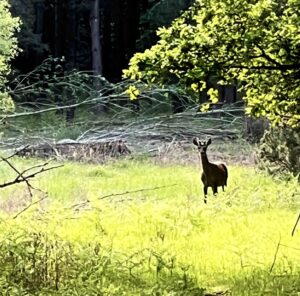
The limited natural regeneration of trees in Scotland has contributed to the long term decline and loss of native woodland.  Indeed, Scotland now has one of the lowest levels of native woodland in Europe; circa 4%.  The regeneration of trees / woodland is restricted by browsing by deer.  Any natural regeneration is largely confined to areas where the deer are excluded.  Deer numbers have increased significantly over recent decades, despite various management programmes.  Estimates suggest that the red deer population might now be as high as 400,000. Red deer no longer have any natural predators.  The wolf was eradicated from Scotland more than two centuries ago.  Some have suggested that wolves should be reintroduced as part of a rewilding program to help control deer numbers.  Across Western Europe, the wolf population is estimated to be 12,000+.  The Netherlands, which is more densely populated than Scotland, has a resident wolf population. Researchers at Leeds University have suggested that there could be significant benefits to the re-introduction of the wolf to Scotland.  Using a predator / prey model, they suggest  the presence of wolves would:  reduce the red deer numbers  allow natural tree and woodland regeneration to occur. Increase carbon dioxide uptake due to the regenerated woodland   The study estimated that a wolf population (of 157 animals) could result in the ‘locking up’ of one million tonnes of CO2 each year. The study acknowledges the potential objections that might be raised by livestock farmers, deer stalkers and the public at large.  However, other advantages that might accrue from the introduction of wolves, for example : increased ecotourism contribute to the NetZero2050 program a reduction in deer-related traffic accidents a reduction in Lyme Disease (ticks on deer can carry the disease)  a reduction in then number / expense of deer culls Details of the Leeds research : https://besjournals.onlinelibrary.wiley.com/doi/10.1002/2688-8319.70016
Deer and Scotland’s temperate rain forest.

Deer and Scotland’s temperate rain forest.

by The blog at woodlands.co.uk, 6 July, 2023, 1 comments

Scotland’s west coast has a number of temperate rain woodlands / forests. They are quite rare. The remnants of oak, birch, ash, native pine and hazel woodlands are small and isolated from each other. They are noteworthy for the diversity and richness of the bryophytes (mosses and liverworts) and lichens; found in abundance on the trees, rocks and on the ground.   Sadly, such woodlands have been in decline for some time. In the past, this woodland covered large areas of the west coast of Scotland, but much has been lost over the last two thousand years.  These woodlands / forests now cover a small area, just under 5% of the land. Factors that have contributed to the decline and loss of this woodland include:- mismanagement,  overgrazing by sheep and  invasion by non-native species [such as Rhododendron ponticum]. According to recent study by Scottish Environment LINK, deer now represent a considerable threat to the woodlands.  Whilst deer are part of woodland ecosystems, when their numbers increase beyond a certain point then they become a significant problem.  Deer numbers are now at historic highs in Scotland/  Money has been made available to manage surging deer populations, for example, through the provision of deer fencing.  However, the report considers that such fencing is “both expensive and often ultimately ineffective”.  More needs to be done if deer damage is to be reduced and allow regeneration of the woodlands. Developing a community approach to deer stalking and management will be important, combined with the use of technologies such as thermal and drone surveying. A greater focus on the management of roe and sika deer, combined with the removal of Rhododendron ponticum will be needed if the woodlands are to flourish and expand. see also : https://www.thescottishfarmer.co.uk/news/23637346.soaring-deer-numbers-see-new-powers-land-managers/   [caption id="attachment_39688" align="aligncenter" width="675"] Rhododendron ponticum, these plants were growing near the River Tay.[/caption] visit https://www.instagram.com/woodlands.co.uk/?hl=en  
Woodland web updates 4

Woodland web updates 4

by The blog at woodlands.co.uk, 24 March, 2021, 0 comments

Beavers Two decades after were first returned to the UK, in Scotland, and 400 years after the species was hunted to extinction in Britain, counties across England and Wales will also become home to new beaver families.   Beavers were hunted to extinction in the UK some 4000 years ago.  A number have been reintroduced in Scotland and the South West, but this year should seen more re-introduction in Wales, the Isle of Wight,  Derbyshire and Nottinghamshire.  It is hoped the beavers’ activities will help restore/create wetland habitats, boosting biodiversity and reducing flood risks. Further details of these reintroductions can be found here. Peatlands As the woodlands blog has reported, peatlands are often under threat, for example, by fire.  The Wildlife Trusts has called on the Government to do more to protect and restore our carbon rich habitats.  The peatlands of the UK are estimated to store 3.2 billion tonnes of sequestered carbon - more than UK woodlands. Greening cities. London is to introduce a green space system in the coming months -  termed the Urban Greening Factor (UGF).  The Green Space Factor is an innovation of the City of Berlin in 1994,  The plan calls for the various boroughs to implement urban greening practices.  Ideas behind the plan have also come from the Swedish city of Malmö.  Here, the Western Harbour (20-minutes from Malmö’s centre), was essentially 175 acres of contaminated soil and deserted docklands, subsequent to decline of the city’s shipbuilding industry. But now, it has been redeveloped with new apartment blocks - each of which is complemented by a green space area.  There are parks, social courtyards and meeting spaces which offers beds planted with a native herbs and wildflowers.  There are also stormwater drains and ponds that offer opportunities for wildlife. The impact of the road network. Our road network is extensive.  There are nearly 700,000 km of road across the UK, which cover some 0.8% of the land.  Roads permeate nearly every part of the country.  Roadless areas are in short supply; they are mainly upland regions (peat bogs, moors, heathland and grasslands).  Pollution from roads can take many forms Light pollution, Noise pollution, Heavy metals,  Nitrogen oxides Particulates (PM2.5 & PM10) Whilst high levels of pollution are localised and associated with the busiest roads, a recent study (by researchers at Exeter University and the CEH) suggest that low levels of pollution from road networks are pervasive, and may extend over 70% of the land area of the UK. As the woodlands blog has reported, hedges can help block pollution to some degree and this has been substantiated by work done by Dr Tijana Blanusa et al at the Royal Horticultural Society.  They investigated the effectiveness of hedges in ‘soaking up’ pollution, comparing different types of shrubs/trees - such as  hawthorn and western red cedar.  They found that on roads with heavy traffic that a species of Cotoneaster (franchetti) was 20% more effective than other species; though shrubs with ‘hairy’ leaves were generally effective in ‘trapping’ particulates.
Next Page »
