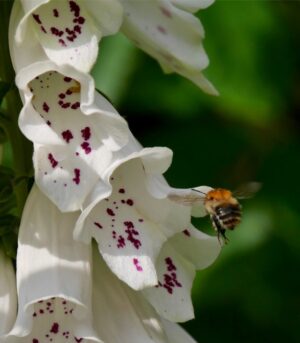
The European hornet.
by The blog at woodlands.co.uk, 29 September, 2022, 10 comments
The European hornet (Vespa crabo) is an eusocial insect. That is to say, hornets live in colonies, with some 200 / 400 individuals in each colony. A colony is founded by a fertilised queen, who emerges from hibernation in spring. Hornet queens are the sole survivors of an old colony after a UK winter and they emerge as the weather finally starts to warm in early spring. They then seek a warm, dry place to start nest construction.
Once a nest location has been secured, they lay eggs that hatch into larvae. The larvae are fed on protein-rich food (chewed up insects) and then they pupate; undergoing metamorphosis [a complete reorganisation of the body]. An adult hornet worker then emerges from the pupa some two weeks later. These are ‘sterile’ female workers, who take over nest building and collecting food for the next set of developing larvae. The developing colony lives within the papery nest its a (a bit like papier mâché), adding to the structure as the colony grows. Twigs, bark and other plant material is broken up, chewed and shaped to form the nest. This material is glued together by their saliva.
Larvae that hatch in the summer are either fertile queens or males. The males (drones) do not contribute to nest building, food foraging etc. But in autumn, the males (drones) and the new queens leave the nest to mate.
The fertilised queens hibernate over winter, emerging in spring to start a new nest. The ‘sterile workers’ and the male hornets die with the onset of winter. In other colonies of social insects, like honeybees, female workers don’t reproduce due to the pheromones that are released by the Queen. This was thought to be the case for European hornets but instead worker hornets enforce ‘sterility’ by physically destroying any worker-laid eggs or the workers laying them !
The food of a hornet is surprisingly varied. They can hunt and capture a wide variety of invertebrate prey (beetles, wasps, moths, dragonflies, robber flies - they may even prey on honey bees). In many ways, hornets are useful in that they predate on a number of garden and agricultural pests.
Much of this prey is then chewed up to feed the growing larvae. In return for this material, the larvae willingly ‘exude’ for the adults a sugary liquid for them to feed on. Adults can also be found feeding on sugar-rich sources such as tree sap, nectar, and ripe fruit. They are more likely to ‘scavenge’ food at the end of summer into autumn rather than hunt.
The head of the insect has dark, prominent eyes, its wings are a reddish-orange, whilst the abdomen is striped with yellow and brown. Hairs are present on both thorax and abdomen but they are not ‘hairy’ like bumblebees. The colour of hornets can vary and a number of regional colour forms are known across Europe. Worker hornets are about 25 mm in length, whilst queens may be up to 35 mm., so significantly bigger than wasps. Partly because of its colour and size, a hornet can be mistaken for the Asian Giant Hornet (previously reported on in the woodlands blog). However, a recent report indicates that the european hornet can attack and kill the Asian Hornet, by biting its head off. Asian hornets are a considerable worry as they attack and kill honey bees, plus their venom can induce life threatening anaphylactic shock.
Breaking news : Asian hornets seen in Essex. https://www.independent.co.uk/climate-change/news/asian-hornet-uk-bees-insects-b2177217.html
In the past, the European hornet was rarely seen in the UK, being largely confined to areas of central southern England, but it has expanded in range in more recent times and is to be found across the South East and even in some more northerly locations. Female hornets (but not males) have a stinger. The venom within the stinger contains mixture of various neurotransmitters (serotonin, dopamine, histamine) as well as a concoction of enzymes. Best avoided !