Woodlands.co.uk

Blog - soil erosion

Moss

Shady by nature

by The blog at woodlands.co.uk, 28 August, 2025, 0 comments

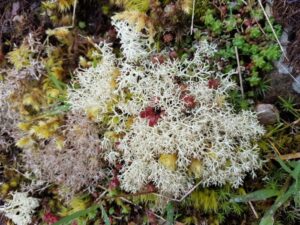
The base of a tree trunk is often covered with a ‘carpet’ of moss and lichens and the branches of the tree may bear ‘decorations’ of different mosses.  In shady areas, there may be a soft, spongey layer of moss underneath the tree.  Mosses are ‘simple’, non-vascular plants. They lack the sophisticated transporting tissues (phloem and xylem).  Nor do they have true roots, instead they have small structures called rhizoids, which help them attach to a surface. They ‘like’ moist places and are dependent on water for their reproduction.   The ancestors of mosses were probably some of the first plants to colonise land (previously there were only algae in the seas), possibly in the Ordovician Period. Mosses rarely grow to any great height, due to the absence of supporting mechanical tissue (lignified tissues, like xylem) but they can form extensive ‘mats’ in damp, shady places (as can liverworts).  Exposed to direct sunlight, they lose water rapidly.  Such mossy mats can, in some situations, help reduce soil erosion. The mats may also allow for the accumulation of humus and soil formation.  A particular example of the accumulation of mossy material is seen with the moss Sphagnum. Sphagnum grows in acidic, marshy conditions, often forming a bog. Low fertility and a cool climate result in slow growth of the Sphagnum (and other plants). The subsequent decay of dead plant material is even slower (due low oxygen levels). Hence, peat forms and accumulates.  Large areas of land can be covered to a depth of several metres with peat.  Bogs are a very effective means of locking up carbon for hundreds, if not thousands of years.   Sadly, many wetlands have been drained and allowed to dry out, then the peat cut from them as a form of fuel.  When peat areas are drained (channels are cut through the peat), they degrade and dry out. They are then at risk of  catching fire as has been seem in recent times:for example, the burning of  Slieve Beagh in Ireland and Langdale Moor in Yorkshire. The Interesting fact : Sphagnum has an interesting property in that can hold water  many times its own weight.  Because of this absorbency, Sphagnum was used as a wound dressing in WW1. https://earthobservatory.nasa.gov/images/150780/irelands-cutaway-peatlands https://www.bbc.co.uk/news/articles/cvg9n0j07epo .
Woodlands web updates 32

Woodlands web updates 32

by The blog at woodlands.co.uk, 20 January, 2025, 0 comments

Loss of nitrogen fixing species. Some plants can ‘fix’ atmospheric nitrogen.  That is they can take nitrogen from the air and use it to make complex nitrogen-containing organic compounds (such as amino acids / proteins).  This fixation of nitrogen is due to the presence of symbiotic bacteria in root nodules.  Gardeners often make use of ‘nitrogen fixers’, such clover, peas and beans to augment soil fertility. A recent study has investigated the changes in the makeup of the flora in European forests (over several decades) from 1940 to 2019.  What they found was that the proportion of nitrogen fixing plants has declined.  The changes did not seem correspond to any changes in temperature  or aridity / rainfall during the time period, but to nitrogen accumulation in the environment.  When nitrogen levels are low, nitrogen fixing plants have an advantage, but when nitrogen levels increase their advantage over other plants is lost. Nitrogen compounds in the soil can result from the intensive use of fertilisers on nearby agricultural land or atmospheric deposition of various pollutants.  Nitrogen levels have increased tenfold since the start date of the surveys.  This loss of nitrogen fixing plants might, in the long term, result in a loss of ecosystem resilience. For further info - visit https://www.science.org/doi/full/10.1126/sciadv.adp7953 The great green wall project. There are a number of large scale tree planting projects, many associated with offsetting global warming.  The great green wall aims to grow a belt of trees some 8000 km in length, and 15 km wide in the Sahara.  The planned route supported trees in the past.  The aim is to ‘stabilise’ the desert, limiting further expansion into the Sahel, as the tree roots help to stabilise the soil, limiting erosion.  Desertification is associated with drought and overgrazing.  The idea of such a barrier was taken up and approved by countries south of the Sahara in 2002, during a special summit.  The trees selected are drought resistant species, that also serve to fertilise the soil and contribute fruits, fodder and fuel wood for local communities. Though millions of trees have been planted, the project needs more funding if it is to succeed. Further details about the great green wall can be found here and here. Dealing with drought ? [caption id="attachment_35526" align="alignleft" width="300"] drought[/caption] Drought is a problem not only for woodlands but also for crops, resulting in substantial food loss across the globe.  The damage to crops is likely to increase as fresh water availability declines.  During drought, the availability of water in the topsoil decreases, leaving water only accessible in the  deeper subsoil.  Plants seek water through their roots and whilst roots generally grow downwards, they also tend to spread outwards to form a network. So, if the roots are mainly located in the upper layer of the soil, they may not be able to absorb water as the soil dries.   Now, research at the University of Nottingham has found that the plant growth regulator abscisic acid plays a critical role in a plant’s response to drought.  The abscisic acid  promotes the production of another growth regulator - auxin.  The two enhance the plant’s geotropic response* - so that the roots permeate deeper into the soil in search of water. Full details in the research paper here : https://www.sciencedirect.com/science/article/abs/pii/S0960982224016439?dgcid=coauthor * Geotropism is a plant’s response to gravity.
The importance of biocrusts

The importance of biocrusts

by The blog at woodlands.co.uk, 4 June, 2024, 0 comments

The soil in many arid ecosystems (for example, savanna, deserts, & shrublands) is often covered by a thin layer of organisms, a community of lichens, mosses, liverworts, fungi, cyanobacteria and other microbes. They form a biocrust in the very top layer of the soil.  These organisms produce a variety of chemicals that glues together the soil particles.  Most biocrusts start of with a single type of organism (often a lichen or cyanobacteria, they are hardy). As these grow, they change the immediate environment so that others can then colonise the area so slowly the community grows.. The resulting biocrusts are important in helping reducing soil erosion and dust production.  Whilst dust can hold nutrients that will benefit plants as and when it is deposited, it can also have negative effects. Dust reduces water and air quality.  Dust storms can be truly massive and terrifying, for example, the 2009 Australian Dust storm. Occasionally, in this country we experience saharan dust that his been carried hundreds of miles on the wind.  If wind-blown dust lands on glaciers, snow or ice sheets then it affects the albedo.  The albedo is a measure of a surface’s ability to absorb and retain energy, or putting it the other way round, the ability to reflect heat / light energy.  Dark coloured objects tend to absorb more light energy than light coloured surfaces.  So if snow or ice becomes coated with dust, it will absorb more heat and may melt.   Biocrusts prevent many millions of tonnes of dusts entering the atmosphere each year.  It is thought that they may cover some 12% of the earth’s land surface.  Soil with a biocrust needs a far stronger wind before it starts to erode.  Sadly, like many other things, biocrusts are under threat due to climate change and shifting patterns of land use. [caption id="attachment_41261" align="aligncenter" width="675"] Church wall being colonised by Lichens[/caption] Biocrusts can also form on walls and buildings, for example, lichens and mosses colonise gravestones.  Whilst biocrusts have positive effects when they form on soils, it is thought that they can have deleterious effects on stone / brick surfaces due to the various organic acids and other chemicals that the colonising organisms can produce.  The production of these chemicals can degrade (weather) structures and lose their integrity / aesthetic appeal.   The Great Wall of China, which once stretched for some 8000+ kilometres, is protected by biocrusts in parts.  Construction of the wall started about. 200 BCE and continued (on and off) till the 1600’s CE.  Much of the wall has now been lost.  Some parts of the wall were made from stone and bricks (held together by sticky rice mortar). Other sections were constructed from ‘rammed earth’, made by compressing natural materials (eg. chalk, gravel, lime) with soil.  Some have regarded these sections of the wall as ‘weak points’.  Recent work by Bo Xiang and colleagues found that the ‘rammed earth’ sections were often covered by a biocrust, (of lichens, mosses and cyanobacteria).  This biocrust actually helps maintain the integrity of the wall by protecting it from wind and water erosion.  It reduces temperature extremes and the porosity of the wall, reducing infiltration and its water holding capacity.  All of these help maintain the integrity of these sections of the wall. If biocrusts are lost, through fire, climate change or human intervention then recovery can be problematic.  Organisms like cyanobacteria may recolonise a site quite quickly by organisms blowing in from nearby and undisturbed areas.  Full recovery of the crust and composition generally occurs more rapidly where the soil is fine  textured and moist. When the soil is coarse and dry then re-establishment of a biocrust may take hundreds or thousands of years. Thanks to Art for lichen image on church wall.  
How "sticky-up things" act as refuges to protect diversity against intensive farming

How “sticky-up things” act as refuges to protect diversity against intensive farming

by Angus, 22 November, 2022, 1 comments

When you look across cultivated fields you are usually surveying an unrelenting monoculture  -of earth or wheat or grass. Lots of pesticides and fertilizers are used and there are regular assaults by bladed machines.  It's bleak for wildlife, whether plants or animals.  But nature is resourceful and clings on where it can.  And within intensive agricultural areas there is a pattern to the small oases of diversity. There is more diversity where an obstacle stops the machines in their track  Sometimes that's a linear feature like a river or a hedge or maybe just a fence, but often it's just a sticky-up object. A tree, a pylon, a pole, or even a wind-turbine.   At the base of objects sticking up in fields you often find a clump of plants, sometimes flowers, and shelter for small mammals and birds.  Taking the train through northern France recently, I realised how extremely industrialised their countryside has become and it's the same in most of Lincolnshire.  Hedges have been removed, single trees are rare and every effort is directed to increasing wheat / crop production.  Diversity is not just discouraged but it is seen as the enemy - a small copse or hedge can harbour swarms of crop-eaters so these have usually been grubbed out (as have many ponds (see the woodlands blog on ghost ponds in Norfolk).  Whatever the spin and rhetoric, the large scale farmer is at odds with biodiversity. The soil is a highly lucrative resource where farmers want to maximise their returns.  Increasingly, they use modern technology with tractors guided by SatNav, planting twice a year, with harvesting dictated by accurate weather forecasts and sophisticated seedlings being protected and fed by brutally efficient pesticides and fertilisers.  Lip service is often paid to the farmers' role in looking after the countryside but in reality most of them are businessmen and businesswoman wanting to optimise returns.  Farming businesses' borrowings and financial objectives don't allow them to spend too long worrying about biodiversity or the "hundred harvests" concern - that, when treated badly, the soil will be mostly gone (e.g fenland blows) or made unusable within 50 or 100 years. Refuge is an important concept in ecology: the idea that an organism gets protection from predation by hiding in inaccessible areas. Coral reefs are an example of habitats where animals can take refuge, and rainforests contain numerous physical refuges. [The concept of refuges or refugia has developed in recent years].   In the case of the arable fields of Britain,  it seems as if it is mainly the "sticky-up things" and linear features  (hedgerows etc.) which provide refuge, but not just from animal predation but from humans and their machinery.  Nature is reacting to humans as if they are the predators. There are thousands of objects in the countryside which act as refuges - it's a benign and unintended consequence of landscape clutter.  For example signposts, pillar boxes, mobile phone masts, abandoned fence posts, and even discarded farm equipment.  These objects can also offer a structure for plants to climb up in their quest for sunlight and they can provide shelter from wind, but mostly they offer protection against the farmer and the machines.  Unfortunately, the natural human instinct is usually to tidy up everything in sight, which often works to the detriment of biodiversity.  It would be better to protect vegetation and stop mammals from being mashed up by mowers / machinery, and it is often the residual sticky-up features that protect these small refuges.  Perhaps we need less rural de-cluttering of the British landscape, and more ‘mini refuges’.  

Next Page »