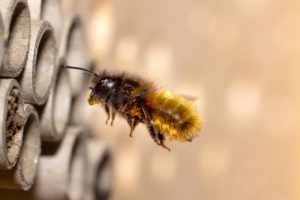
Bees, agrochemicals and the microbiome
by The blog at woodlands.co.uk, 23 October, 2023, 0 comments
Mason bees and agrochemicals
The blog has reported many times on the threats to bees - money bees, bumblebees and ‘wild bees, such as mason bees / solitary bees. The threat to bees from neonicotinoids has been well documented, now there is a report that suggests that certain other agrochemicals may be harmful to bees.
Researchers at the Julius Maximilians University at Würburg have been investigation the effect of a fungicide (Fenbuconazole) on the reproductive behaviour of horned mason bees (Osmia cornuta). A number of Osmia species are used to improve pollination in fruit and nut crops. They are efficient pollinators having a special pollen collecting / carrying structure called a scopa.
Mason bees are solitary bees. Each female is fertile and makes her own nest and no worker bees for these species exist. In the Spring, male and female bees emerge from a nest. The males generally exit first and remain near the nest, ready to mate with the females. A female bee selects a mate on their ‘smell’ / odour and the ‘quality’ of their thoracic vibrations (achieved through muscle contractions). After mating the males soon die. The females search for and select a nest site, visiting flowers to collect pollen and nectar for their nests. Once a certain amount of food has been collected within the nest, the females lay their eggs on top of this material (in a series of cells) and then seal off the nest. The eggs hatch to form larvae which feed upon the food and within weeks forms a cocoon, in which it continues to develop to an adult.
Though the fungicide (Fenbuconazole) is considered to be of low toxicity and the bees were exposed to a sub-lethal dose, nevertheless the Fenbuconazole had significant effects on the bees. Pesticide exposed males were more likely to rejected by the females, compared to ‘control’ bees that were not exposed to the fungicide. The thoracic vibrations of the exposed males were less powerful / noticeable and the composition of their odour or smell was different. The smell of the bees is dependent on particular hydrocarbon compounds in their cuticle - their exoskeleton. It is possible, therefore, that the mating behaviour and reproductive success of these bees is being affected by agrochemicals.
Carpenter bees.
The microbiome refers to the collection of micro-organisms that lives on or in us, particularly within within the gut. Whilst these micro-organisms are small, they contribute to our health and ‘well being’. They offer protection against pathogens, help our immune system develop, and enable us to digest.
Just as we have a microbiome so do bees. Scientists as York University (Canada) have been investigating the microbiome of three species of carpenter bees (from North America, Asia and Australia). The term "carpenter bee" comes from their nesting behaviour, most species burrow into plant material such as dead wood or stems, though a few create tunnels in soil.
Social bees (like honeybees and bumblebees) acquire their microbiome by interacting with their hive or nest ‘mates’. Solitary bees, like the carpenter bees, get their microbiome from the environment as they forage for food. The researchers found that:
The bees’ microbiome contained Lactobacilli, which are important for good gut health, helping protect against fungal pathogens and facilitating nutrient uptake.
They also discovered crop pathogens in the microbiomes of the carpenter bees which were previously only found in honeybees. Whilst these pathogens are not necessarily harmful, it is possible that the wild bees could be vectors for spreading disease.
With thanks to Pixabay (Umsiedlungen and Sabinem34) for the above images of bees
Finding flowers.
Research at the University of Exeter has shown that bees can distinguish between various flowers through a combination of colour and pattern. This selectivity is achieved despite the ‘acuity’ of a bee’s vision being quite low (about a 100 times lower than ours) - this means they can only see the pattern of a flower when they are quite close (a matter of centimetres). The researchers analysed a significant amount of data on plants and visiting bee behaviour, and they used experiments involving artificial shapes and colours. One particular finding was the importance of the contrast between the outside of the flower and the plant’s foliage. This seemed to help beesfind their way to the flowers quickly .