Woodlands.co.uk

Blog - sphagnum

Reviving peatlands.

Reviving peatlands.

by The blog at woodlands.co.uk, 25 May, 2026, 0 comments

For many years, people who lived near peatlands would cut sods of peat, allow them to dry and use them for fuel.  This, and other human activities such as Draining for agriculture, Deforestation Burning for ‘sporting’ purposes Testing of ordinance Tin streaming (in the case of Dartmoor) have left areas of peatland in a parlous state.  Often there are deep gullies and ditches, so water runs off and the peat dries out, no new material is formed  It is estimated that some 80% of peatlands in the UK are in a damaged or degraded state. They now represent a carbon source rather than a store. When healthy, peatlands can store twice as much carbon as forests, playing a part in reducing global emissions of carbon dioxide and helping to reduce / control flooding, and supporting biodiversity. Sadly, peat forms very slowly, forming (roughly) at a rate one millimetre per year. Peat is formed by the decomposition of plant material under water logged conditions. So at its deepest point, the peat on Dartmoor in nine metres in depth and therefore represent thousands of years of history and can be an archaeological treasure trove. [caption id="attachment_43175" align="aligncenter" width="675"] Scottish moorland[/caption] The UK’s Climate Change Committee has a target that 50% of upland peatlands and 25% of lowland peatlands should be restored to a natural condition by 2050.  If nothing is done, and the climate becomes warmer and drier, then the peatlands of the south west of England could be a thing of the past. Efforts are being made on areas such as Dartmoor to restore the landscape.  The gullies and ditches are being blocked, so that rainwater is retained and the water table is raised so that the wetness of the area is restored.  BY ‘reprofilling’ the landscape, pools will again form and sphagnum moss and other plants will grow and the process of peat formation will begin again.   In recent years, a project  [The South West Peatland Partnership] funded by Natural England South West Water & The National Trust has restored some 1700 hectares of damaged peat bog in the South West.  Whilst this is a long term project, some promising results have been observed such as an increases in the number and species of dragonflies.  They represent food for the next trophic (feeding) level, so that perhaps in time the number of wading birds and mammals on the moor may increase. Other areas of peatland, such as the blanket bogs of Caithness and Sutherlands and the Peak District need to be monitored as they too are at risk. Details of current work can be found here.
Fire in the bog

Fire in the bog

by The blog at woodlands.co.uk, 23 September, 2025, 0 comments

This year's Spring saw a number of fires damaging important UK wildlife habitats.  In Northern Ireland, wildfires have often spread through gorse, which is widespread, often dry and flammable.  One such fire occurred at Slieve Beagh.  The area is mainly blanket bog, with small lakes and streams.  The fire here raged for three days and has destroyed a large area of blanket bog.  It was described as a ‘hot burn’, in that it advanced slowly and burned deep into the blanket bog. Hotter and drier Springs have contributed to greater amounts of dry material,  The bog is the habitat of the hen harrier - an endangered species, as well as being important site for migrating and over-wintering birds. [caption id="attachment_42436" align="aligncenter" width="675"] Moorland[/caption] There will now been a concerted effort to restore the area, which was designated a RAMSAR (wetland) SITE in 1999 and is an area of special scientific interest.  Whilst the burnt area is now green again, the new vegetation lacks the variety of original plant species.  Much is grass, which could contribute to another fire; it will take many years for species like sphagnum moss, bog myrtle and bilberry to return. Sphagnum moss creates a habitat that helps in formation of. Peat.  Peat forms in wetland conditions, when water accumulates and oxygen is limited slowing the rate of decomposition.  If the bog flora can be re-established, then insects will return and, in turn, the birds.  An absence of predators, coupled with suitable weather would see successful broods of chicks raised, and a functional ecosystem restored. The RBCT (River Blackwater Catchment Trust) is working with various agencies to create a fire plan. Burns apart from destroying the habitat, release vast quantities of carbon dioxide from the stored carbon in the peat.   The plan is to include  the introduction of grazing, which should help control the amount of accumulation of flammable vegetation, and  make use of technology such as drones to find and fight fires.   Drones might also spot people, who are frequently responsible for such fires.  
Moss

Shady by nature

by The blog at woodlands.co.uk, 28 August, 2025, 0 comments

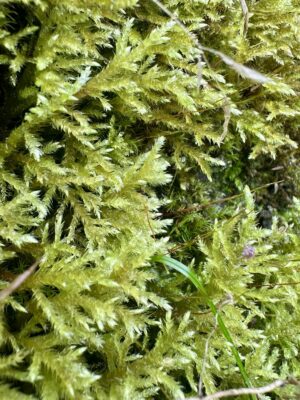
The base of a tree trunk is often covered with a ‘carpet’ of moss and lichens and the branches of the tree may bear ‘decorations’ of different mosses.  In shady areas, there may be a soft, spongey layer of moss underneath the tree.  Mosses are ‘simple’, non-vascular plants. They lack the sophisticated transporting tissues (phloem and xylem).  Nor do they have true roots, instead they have small structures called rhizoids, which help them attach to a surface. They ‘like’ moist places and are dependent on water for their reproduction.   The ancestors of mosses were probably some of the first plants to colonise land (previously there were only algae in the seas), possibly in the Ordovician Period. Mosses rarely grow to any great height, due to the absence of supporting mechanical tissue (lignified tissues, like xylem) but they can form extensive ‘mats’ in damp, shady places (as can liverworts).  Exposed to direct sunlight, they lose water rapidly.  Such mossy mats can, in some situations, help reduce soil erosion. The mats may also allow for the accumulation of humus and soil formation.  A particular example of the accumulation of mossy material is seen with the moss Sphagnum. Sphagnum grows in acidic, marshy conditions, often forming a bog. Low fertility and a cool climate result in slow growth of the Sphagnum (and other plants). The subsequent decay of dead plant material is even slower (due low oxygen levels). Hence, peat forms and accumulates.  Large areas of land can be covered to a depth of several metres with peat.  Bogs are a very effective means of locking up carbon for hundreds, if not thousands of years.   Sadly, many wetlands have been drained and allowed to dry out, then the peat cut from them as a form of fuel.  When peat areas are drained (channels are cut through the peat), they degrade and dry out. They are then at risk of  catching fire as has been seem in recent times:for example, the burning of  Slieve Beagh in Ireland and Langdale Moor in Yorkshire. The Interesting fact : Sphagnum has an interesting property in that can hold water  many times its own weight.  Because of this absorbency, Sphagnum was used as a wound dressing in WW1. https://earthobservatory.nasa.gov/images/150780/irelands-cutaway-peatlands https://www.bbc.co.uk/news/articles/cvg9n0j07epo .
Restoring peatland.

Restoring peatland.

by The blog at woodlands.co.uk, 12 January, 2023, 0 comments

In recent times, peatlands and areas of blanket bog have been recognised as important parts of our landscape.  Blanket bog is mostly found in wetter and more northern regions - in parts of Ireland and Scotland; in England a lot is to be found in Yorkshire.  Peatlands and bogs play an important part in controlling the run off of water from hillsides, plus they also represent an enormous store of ‘sequestered carbon’. The remains of plants (and animals) have been buried in wetlands but have not decomposed fully (usually due to the acidic conditions). Sometimes large chunks of trees are found in peat bogs, and occasionally even human remains (for example Tollund man) have been found.  Some of the peat deposits are incredibly thick and the material stored in them may be many thousands of years old.  Moorland ‘management’ techniques have been implicated in the severe erosion of certain areas, and the peat (that has accumulated over thousands of years) is being washed away. [caption id="attachment_32147" align="aligncenter" width="650"] Water logged conditions are ideal for peat formation[/caption] The UK has lost many areas of wetland habitat in recent times. A research team lead by Dr Swindles (Leeds University) examined many peatlands and looked at the changes that have occurred over the last two millennia.  They found that the majority of peatlands have become drier.  This drying out changes the role of a peatland from carbon sink to carbon source; i.e. releasing carbon into the atmosphere - contributing to global warming and climate change.  The streams and rivers that permeate these areas often turn a deep, rich brown as this organic material is washed out. [caption id="attachment_34388" align="aligncenter" width="650"] Stream flowing through peat moorland[/caption] Various efforts are being made to help stabilise these valuable ecosystems and a number of techniques to have been tried. At Fleet Moss, a North Yorkshire moor between Wharfedale and Wensleydale, the Yorkshire Peat Partnership project has been working to restore areas of degraded peatland by creating dams and reintroducing wildlife.  The conservationists have been using grass seed to try and stabilise the peat, hoping that as it grows and extends its roots, it will stop the peat from being washed away while allowing bog plants and sphagnum to flourish.  Sphagnum moss can hold 26 times its weight in water.   Their work is already bearing fruit,.  Originally, the land was largely acres of heather, with little variety in terms of the animals and plants that had made a home there. But over time, owls, frogs, foxes and weasels have appeared.  With time, the grass should stabilise the peat and allow bog plants to establish themselves. However, it has not been an easy process. Whilst the scattering of grass seed has worked in some areas, this does not always work everywhere, particularly on exposed sites; seeds can be battered by rain and wind.   Even at the height of summer, the weather on some of England’s highest terrain can be fierce, and scattering grass seeds on areas that are battered by wind and rain has proved to be problematic. So now in some areas a hydroseeder is being used where grass colonisation has failed. This is where green sludge and the bioengineering company TerrAffix come in. TerrAffix uses a hydroseeder to spray the mix of brash (chopped heather), grass seeds, fertiliser and a special adhesive (or tackifier), to areas facing particular challenges.  This equipment has been used to reseed prairies in the States, and can also be used on the steep slopes of motorways,   It will be some time before it is known whether this technique is successful in boggy and peatland areas.  If it does show signs of success then plugs of plants such as bog asphodel and sphagnum will be added, in the hope of recreating a more natural and diverse flora for the areas.   Further information on the restoration of peatlands can be found on Dr. Emma Shuttleworth's web pages and in articles such as this. Featured image is a 'book' made from bog oak.  
Woodlands web updates : 20

Woodlands web updates : 20

by The blog at woodlands.co.uk, 28 October, 2022, 1 comments

Moss puts a brake on peak flow and flooding. “Moors for the future” have been working in the Peak District to investigate the run off of water after rain.  Often after a storm, rain water will run off a hillside unimpeded so that communities downstream in valleys are vulnerable to flooding.  Moors for a future have been planting upland areas (on Kinder Scout) with Sphagnum moss.  They have planted some 50,000 plants of the moss.  Prior to the planting of the moss, the surface might be bare, and rainwater would run straight off.  It was found that the moss dramatically slowed the run off of water, and the volume of water discharged from the hillside, preventing rivers from becoming inundated.  Each moss plant can hold up to twenty times its own weight of water.  The sphagnum moss also protects the underlying peat, so that new layers of material can accumulate - allowing for carbon sequestration. Help from vegetables ? More and more bacteria are now resistant to many types of antibiotics, consequently it is increasingly difficult to treat certain types of bacterial infection / disease.  In some cases, this is due to the production of a biofilm.  Bacteria grow on many surfaces within our bodies and as they grow and multiply they may encase themselves in a matrix of extra-cellular material that they produce ( as seen in Pseudomonas sp). Research workers at the Ben Gurion University have found that certain compounds from cruciferous vegetables, such as broccoli, can break down these bacterial films. Cruciferous vegetables include Cabbages, Cauliflower, Brussels sprouts, Kale, Radish, Kohlrabi and Mustard. The chemical DIM (3,3 diindolylmethane) was able to disrupt the biofilm.  When introduced to an infected, wound, it was found to speed up the healing process. It is hoped that further work will lead to a commercially viable product for the treatment of certain infections. (Thanks to Ulleo on Pixabay for adjacent image). ‘Help Signals’ from oil seed rape. Oilseed rape (or rapeseed, Brassica napus) is a major crop in many parts of the country.  It provides an oil and is also contributes to animal feedstuffs and biofuels.  Great swathes of the country turn yellow when the plant is in flower during the summer months.  These monocultures are ideal for the animals that feed on the plants, these range from insects, to nematodes, slugs and wood pigeons   One particular pest of oil seed rape is the Common Pollen Beetle (Brassicogethes aeneus).  The female beetles lay eggs in the flower buds of and the larvae develop within the flowers.  Both adults and larvae feed on the pollen and nectar in the flowers. Plants have limited means of fighting attackers.  They may construct structural defences, as discussed in the woodlands blog, or they may use chemical defences.  When bitten by a marauding herbivore some plants emit volatile organic compounds (VOC’s).  As the pollen beetles feed, the rapeseed releases VOCs which attract the attention of other insect - notably those that will lay their eggs into the larvae of the pollen beetles. These insects are usually from the same family as bees, wasps and ants - the Hymenoptera (insects with membranous wings and a ‘narrow waist’.   The pollen beetle larvae are then ‘eaten’ from the inside by the developing parasitoid larva.  This effectively constitutes a form of biological control.  Interestingly, the pollen beetles preferred to lay eggs into rapeseed plants plants growing with high levels of N fertilisation, whereas their parasitoids favoured more moderate levels of N fertilization.  This work was undertaken  at the Estonian University of Life Sciences. Finding the flowers. Research at the University of Exeter has shown that bees can distinguish between various flowers through a combination of colour and pattern.  This selectivity is achieved despite the ‘acuity’ of a bee’s vision being quite low (about a 100 times lower than ours) - this means they can only see the pattern of a flower when they are quite close ( a matter of centimetres).  The researchers analysed a large amount of data on plants and visiting bee behaviour, and experiments involving artificial shapes and colours.  One particular finding was the importance of the contrast between the outside of the flower and the plant’s foliage.  This seemed to help bees quickly find their way to the flowers.
Mosses in woodlands

Mosses in woodlands

by The blog at woodlands.co.uk, 6 November, 2021, 1 comments

As we move through Autumn,  the leaves of deciduous trees have ‘done their job’.  Their capacity for photosynthesis dwindles (as does the light and temperature.  In fact, the leaves become a ‘liability’ to a tree, in that they would make use of the reserves that have been stored away. Also, the leaves offer resistance to the winds of winter so a tree is likely to sustain damage. If branches are lost from the stem,  then bacteria and / or fungi could enter.  The leaves are ‘discarded’ as Autumn progresses.  The green colour of the chlorophyll is lost and other colours emerge - reds, oranges and yellows. These colours are associated with different pigments, the carotenes, xanthophylls and the anthocyanins.   As the leaves are lost so the trunk and branches becomes more apparent, but they are not necessarily ‘naked’ - devoid of cover.  Indeed, walking through a woodland at this time of year, one is often struck by the abundance of mosses. Tree trunks are often laden with ‘carpets’ of moss and their branches bear ‘decorations’ of many different mosses.  Beneath the tree, there is often a soft, spongey layer of mosses. Mosses are bryophytes.  They are ‘simple’, non-vascular plants ; that is to say they do not have sophisticated transporting tissues (of phloem and xylem).  Nor do they have true roots, instead they have structures called rhizoids (which may be uni or multicellular). They live in moist places, indeed they are dependent on water for their reproduction. Mosses or rather their ancestors were some of the first plants to colonise land (which was the rather inhospitable rock of the Ordovician period), previously there were only algae in the seas.  Mosses develop sex organs, The male organ is called is called an antheridium, it produces male gametes that can move by means of a flagellum.  These gametes swim in a film of water towards the female organ (an archegonium).  When the male and female gamete fuse, the structure grows to form a sporophyte.  This eventually produces a capsule, which releases spores that grow on to form a new generation.   Mosses seldom grow to any great height, mainly due to the absence of supporting mechanical tissue but they can form extensive mats in damp, shady places (as can liverworts).  These mossy mats can in some situations prevent soil erosion, and in others allow the accumulation of humus and soil enrichment / formation.  An extreme example of the accumulation of mossy material I can be seen in the case of the moss Sphagnum.  Sphagnum is unusual in that can hold many times its own weight in water; because of this absorbency, Sphagnum was used as a wound dressing in WW1. It grows in acidic, marshy conditions, often forming a sphagnum bog. The low fertility and cool climate result in slow growth of the Sphagnum (and other plants). The decay of dead plant material is even slower (due low oxygen levels). Hence, peat forms and accumulates.  Large areas of the land can be covered to a depth of several metres with peat.  Peat bogs are a very effective means of carbon sequestration, locking away carbon for hundreds iff not thousands of years.  Unfortunately, many have been drained and allowed to dry out  and / or the peat cut from them as a form of fuel.  When peat areas are drained (channels are cut through the peat), they degrade and dry out.  Then, they are then at risk of burning as has been seem in recent years -for example, in the U.K (Saddleworth Moor). [caption id="attachment_39795" align="aligncenter" width="675"] Moss (Dicranum?) growing with Lichen (Cladonia sp)[/caption] 'Mossy ball', 'autumn leaves ', moss and lichen photos - thanks to Art Symons.