Woodlands.co.uk

Blog - tannins

Oaks playing clever

Oaks playing clever

by The blog at woodlands.co.uk, 11 September, 2026, 0 comments

Once upon a time, the gypsy moth lived only in the Fenlands of eastern England, where its caterpillars fed upon bog myrtle and creeping willow.   As the Fens continued to be drained and agriculture expanded, this native population died out in the early part of the C20th.  However, many years later, a colony of the European form of the moth was found in Epping Forest. This form of the moth is polyphagous, that is, its caterpillars can feed on a variety of plant leaves. They have a particular penchant for the leaves of oak and poplar.  Since its ‘introduction’, this form of the moth has spread to many parts of south-east England. The caterpillars of this moth can denude a tree of its leaves if the infestation is heavy.  Repeated attacks combined with drought can result in the death of trees. The trees do have a defence mechanism which is to increase tannin production, which makes the leaves much more bitter.  But this comes at a cost to a tree, namely an increase in metabolism and energy expenditure to make these materials. [caption id="attachment_43799" align="aligncenter" width="675"] Gypsy moth caterpillar. [Thanks to Bernell MacDonald & Pixabay][/caption] Research has indicated that oak trees have ‘solved’ the problem in a different way.  If a tree has been subject to a significant attack by these caterpillars/moths, then in the succeeding year it delays the opening of its leaves by a few days.  The effect of this is that when the caterpillars emerge, the leaves that they depend upon are still ‘sealed away’ in their buds. So, the caterpillars have little or nothing to eat.  The effect of this is to reduce the damage to the tree by over 50%! The research work was carried out over a large area in Northern Bavaria and made extensive use of radar satellites.  The satellites were able to identify which trees had been stripped bare and how they reacted in the following year.  Further details of this work can be accessed here: https://www.nature.com/articles/s41559-026-03071-9
Grey squirrel damage.

Grey squirrel damage.

by The blog at woodlands.co.uk, 22 July, 2024, 0 comments

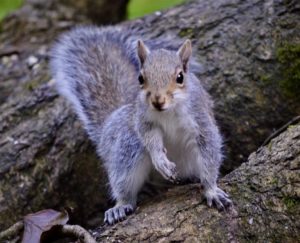
Much has been written about the explosion of the UK deer population in recent times, and the damage to woodlands through their browsing activities.  However, the grey squirrelis associated with tree damage.  The grey squirrel is not just the 'cheeky chap' who steals the bird food in the garden, it is a serious pest.    The grey squirrel is a non-native species.  It was introduced in the 19th century.  The squirrels have spread across the country and have displaced the native red squirrel from many areas (either through competition or disease).  The grey squirrel's bark stripping activity now poses a threat to the sustainable management of woodlands. Gnawing of the bark means that they can get to the sweet, sap filled tissue (phloem) just beneath the bark. This tissue is responsible for the movement of sugars and other organic molecules around the plant (known as translocation). If the gnawing extends around the stem then the tree is ‘ringed’ [i.e a complete circle of bark and underlying tissue is removed]  then the tree us likely to die.  The squirrels tend to take bark from the main stem (and branches). The bark stripping may : Lead to the loss of particular tree species (for example, beech) Lead to the loss of insect / spider and fungal species associated with the loss of tree species, i.e. a loss of biodiversity allow fungal infection of the tree Reduce carbon capture Reduce the economic value of timber Act as a disincentive to creating new woodland for timber In order to reduce squirrel damage, it is important to Start inspecting for damage in late February as damage typically occurs in early Spring.  Examine the base of trees for damage. Look for ‘tester patches’ made by squirrels (to which they may well return later). Check young, broadleaf trees as they are particularly favoured by the squirrels.  Oak and beech are quite vulnerable to damage (see image of damaged beech trunk below). Recent research* at Bangor University has investigated the microbiome of the squirrel in relation to its bark stripping activity.  The microbiome of the gut refers to the various micro-organisms found with the intestines.  Analysis of bacterial DNA found in the colon of great (and red) squirrels revealed that grey squirrels had 'oxalobacter' bacteria in their colons.  These bacteria are able to 'release / access' calcium from the tree bark to the squirrels.  Calcium is an important nutrient in terms of bone building and is also involved in muscle contraction. had  a more diverse bacterial population in the colon. These findings may help explain why the grey squirrel 'outcompetes' the red squirrel.  Their more diverse gut microbiome may mean that they can access a greater range of resources. For example, grey squirrels can digest acorns, which red squirrels cannot;  this is possibly associated with tannin content of acorns. In order to reduce damage in a woodland, the number of grey squirrels may need to be managed.  This can be done though trapping or shooting.  Trapping is a legally acceptable and effective way of controlling grey squirrels in most situations. Grey squirrels can be trapped throughout the year though March to September is a good time as food is less abundant. Through autumn, berries, nuts and seeds [natural foods] are available so trapping is less successful.  Details of the various types of traps and their use / placement may be found at: https://greysquirrelcontrol.co.uk/trapping-method.php https://www.britishredsquirrel.org/wp-content/uploads/2016/07/Grey-Squirrel-Best-Practice.pdf https://basc.org.uk/pest-and-predator-control/grey-squirrel-control-with-live-capture-traps/ https://www.britishredsquirrel.org/wp-content/uploads/2016/09/Trapping-Protocol.pdf  https://bpca.org.uk/a-z-of-pest-advice/squirrel-control-how-to-get-rid-of-squirrels-bpca-a-z-of-pests-/188983 To go down the ‘shoot to kill’ route then there are a number of rules and regulations to observe.  Details may be found in the link below : http://www.britishredsquirrel.org/grey-squirrels/grey-control/ It is hoped that eventually a form of oral contraception will be developed, which will offer a non-lethal and humane means of population control. Full details of this research work may be found here
Parts of a tree (3): the leaf

Parts of a tree (3): the leaf

by The blog at woodlands.co.uk, 21 July, 2023, 0 comments

Across the world there may be three trillion trees. A mature tree may have 200,000 leaves, so there are a lot of leaves in the world - not counting those on herbaceous plants, grasses and shrubs.  The broad structure of a leaf is outlined here in woodlands.co.uk Tree ID. The leaf is the site of photosynthesis, providing food for the tree, and oxygen for us.  As the leaf is rich in nutrients, it is a source of nutrition for many organisms - other than the tree.  Oak trees are said to support over 2000 species, ranging from mammals, birds, beetles, spiders, fungi - through leaf-based food chains.  Leaves also support many micro-organisms through the detrital food chain (the decomposition of leaves in the litter layer and the soil). We do not eat many tree leaves, though some do make their way into our diet.  For example, the evergreen shrub Camellia sinensis is widely grown in many parts of the world for the production of tea.  The young leaves can be picked in spring and dried to make tea.  Leaves of other plants are used in various herbal infusions or for flavouring such as bay, sage, oregano, thyme etc. The fact that leaves are attractive to so many herbivores means that trees (and other plants) take measures to protect themselves. Some measures are physical - such as spines, thorns, prickles etc.   But when is a thorn a thorn, rather than a spine or a prickle?  These terms are used casually and interchangeably.  Botanically speaking, they are all ‘spinose structures’ that is hard, rigid extensions or modifications of leaves, roots, or stems - all of which have sharp, stiff ends and all have the same role - to deter animals from eating the plant that bears them.  Plants that bear sharp structures that deter herbivory are termed spinescent.  There are differences between these various ‘structures’. thorns are derived from shoots (they may be branched or not, may or may not have leaves). The thorns of Hawthorn (Crataegus monogyna) can bear leaves. spines are derived from leaves (they may be formed from all of the leaf or just part of it and like thorns they have vascular tissue*) prickles are derived from the epidermis (the outer layer of cells of a stem, root or a leaf).   Prickles may be found almost anywhere on a plant and they do not have vascular tissue inside.  Wild lemon and lime trees (Genus: Citrus) have spines, which protect young plants and indeed the fruits. The defences on roses are often described as thorns, but they are prickles, as they do not have vascular tissue (xylem and phloem) inside them. Sometimes, the leaf epidermis forms smaller, ‘simpler’ physical barriers called trichomes.  These are outgrowths of epidermal tissue but generally consist of only a few cells which form a defence against small insects.  Equally, a thick,  waxy cuticle on a leaf may be something of a deterrent to smaller insects. Leaves sometimes form ‘teeth’ on the leaf margins and leaf apices.  A classic example of this is seen in Holly.  Holly leaves that develop at ground level are wavy, with large triangular ‘teeth’, bearing spines.   As the tree grows and holly can reach up to 80 feet,  the leaves become less spiny. The spines offer protection against grazing animals at the lower levels but are no longer needed when the trees reach a certain height. While physical defences such as spines, prickles and trichomes can deter various herbivores,  chemical defences may also be deployed.  Chemical defences can take different ‘forms’, such as  [caption id="attachment_28705" align="alignright" width="300"] Oozing latex - Euphorbia[/caption] tannins and phenolics. These create an bitter taste, they are complex polyphenols built from several phenolic molecules. Tannins are common in leaf tissues - particularly in the cells on the top surface of a leaf.  Scale leaves of buds are often particularly rich in tannins, reducing  the palatability or "tastiness" of the tissue thereby offering protection from herbivores.  Alkaloids are again usually bitter tasting compounds -, many of them derived from amino acids. Glycosides, as the name suggests, contain a sugar that is joined to another chemical, such as cyanide (as seen in bitter almonds (amygdalin). Another possibility is that leaves may emit chemicals (aka VOC’ volatile organic compounds, scents, aromas) that deter insect visitors, or if a leaf is under attack by a insect pest then a leaf may release a VOC to ‘warn’ nearby plants of the attack so that they produce chemicals that make the leaves distasteful. How long a leaf lives is incredibly variable, it may be eaten within days of its formation, it may last till autumn or it may last for years.  Many trees of temperate climes are deciduous, that is they shed their leaves come the shorter days of autumn.  The advantage of this is that the tree offers less resistance to the winds of winter, so is less likely to suffer physical damage (also true of snowfall).  The tree enters a state of dormancy until spring.  If in spring the tree produces flowers before the leaves (like Blackthorn) this  can facilitate wind dispersal of the pollen.  However, losing leaves each year means that their nutrients are either lost or have to be moved out and stored somewhere else.  Having longer lasting leaves means that nutrients are retained, which is a distinct advantage in a nutrient poor, harsh environment.  The longest lived leaves are found in a plant of the Namib Desert : Welwitschia.  This plant has two leaves throughout its life of some two thousand years.  The leaves may reach a length of 4 metres, the ends die or get worn away but the base generates new tissue.   Welwitschia is a type of Gymnosperm. Image (with thanks) by Nhelia from Pixabay  

Next Page »