Woodlands.co.uk

Blog - ticks

Sarah on the tractor

Woodland web updates 34.

by The blog at woodlands.co.uk, 24 March, 2026, 0 comments

Biodiversity after the Black Death. The plague or black death swept across Europe and the UK (from 1347 - 1353, resulting in millions of deaths.  Some studies suggest that it killed between a third and half of the population.  As a result, there was a much reduced workforce, villages were deserted, farmland was abandoned, traditional land and woodland management fell by the wayside.  It was suggested that all of this lead to a significant rewilding event and an increase in biodiversity - both plant and animal. However, an analysis at York University of fossil pollen studies across Europe suggests a 'different story’.  Plant diversity did not increase after the plague, in fact it fell. Plant diversity fell for the next 150 years.  This suggests that some plant species depend on the human disturbance within the various ecosystems (farming, grazing, woodland management, all help seed dispersal etc).  However, mediaeval practices were far gentler than today’s mechanised, industrial scale farming and the clear cut felling of woodlands. Ploughs were pulled by oxen or hand, woodlands were managed by coppicing etc.  So reducing human activity does not always lead to a 'rebound of nature’. The contribution of small woodlands. Over the centuries, our woodlands and forests have been ‘decimated’.  Our woodland / forest cover has been reduced to a small percentage of what it was by farming, felling, building of transport networks and the expansion of towns and cities.  Consequently, there now exist many small patches of woodland in an an agricultural landscape. These ‘islands’ differ in size, degree of isolation, and age. It would be easy to dismiss such ‘islands’ are being of no importance.  However, recent studies suggest that they can make a significant contribution to the biodiversity of the landscape, partly through the ‘edge effect’. The edges of woodlands are exposed to the surrounding environment. Consequently, they receive more sunlight and often nutrients from the surrounding agricultural land.  They are generally richer in species like brambles, hawthorn, willow, offering food for deer, butterflies and other species.  They may also store more carbon in the topsoil than older woodlands - acting as carbon sinks.  As the edges of these woodlands tend to be drier and hotter than woodland itself, there is a lower risk of tick borne disease as fewer tick larvae survive under such conditions.  They are therefore making a significant contribution to diversity and ecosystem services in an agricultural landscape. Such small and often isolated woodlands need to be managed. so they do not become overrun by ivy and bracken if they are to contribute to the diversity of the landscape. A singular advantage of owning a woodland with an edge is that it may offer a good view of the surrounding landscape, which one might sit and enjoy. [caption id="attachment_43124" align="aligncenter" width="675"] View from a scottish woodland[/caption] For further information about the edge effect see  Julian Evans' video on woodlandTV at YouTube : [embed]https://youtu.be/D2buIXiz1sk?si=zhsUiter2pjvyZAv[/embed]
Can bracken be defeated?

Can bracken be defeated?

by The blog at woodlands.co.uk, 20 February, 2026, 5 comments

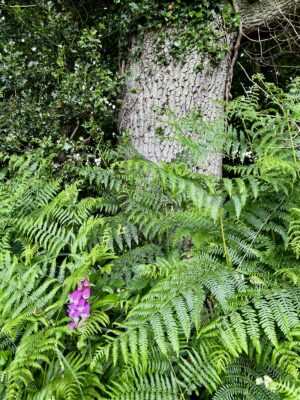
Pteridium aquilinum otherwise known as Bracken, is a common fern in many woodlands.  It is a vigorous and resilient species found throughout the UK.  When trees are felled or spaces appear in woodlands, bracken is quick to colonise taking advantage of the increased light. It grows quickly and its fronds can limit the growth of young trees through its dense shading. Similarly at the end of a growing season, the dying fronds can literally smother germinating seedlings and young saplings. Before dying down, bracken can store many materials in its extensive underground rhizome system.  It can tolerate adverse weather and difficult soil conditions  but generally prefers not to be in waterlogged  soils. It is not subject to significant grazing pressure or attack by insect pests or pathogens.  Consequently, it is a highly competitive species, reducing biodiversity.  Some woodland plants can survive in its presence, if they grow in early spring before the emergence of the fronds. [caption id="attachment_5892" align="alignleft" width="240"] A TICK[/caption] Bracken contains metabolites, which when ingested by animals, like cattle, have been linked to cancer of the bladder. It contains a toxin Ptaquiloside and the young leaves when crushed or eaten release hydrogen cyanide. Bracken is also known to harbour ticks, which can spread Lyme Disease. So, it not surprising that bracken is regarded as a weed by managers of woodland, field and pasture; it needs to be controlled, preferably eliminated.  But how to do this is problematic.  A number of strategies have been employed with varying degrees of success.  In woodland, the main objective is to suppress its vigour so that saplings can fully establish themselves . In the past, bracken had a number of uses – for example, as animal bedding which was later composted to give a nutrient-rich mulch.  Also, used for thatching, as a source of potash (pot ash = plant ashes soaked in water in a pot giving a soluble form of potassium K+).  This harvesting of bracken in historical times probably helped limit its spread. However, it is now spreading and its dominance in some areas / habitats is a concern. [caption id="attachment_15642" align="alignleft" width="300"] Rolling bracken[/caption] Bracken can be weakened by the cutting or crushing of the fronds, particularly if this is repeated on a regular basis.  This is both time consuming and expensive. Ploughing the soil, this cuts the underground rhizomes, exposing them on the  surface where they might dry out or freeze.  Ploughing has to be done carefully, as can significantly disturb the soil which can lead to erosion. Pigs can have the same effect as ploughing if the soil is shallow.  Generally these methods are now used. Other techniques included the burning of leaf litter and woody material but this has little effect on reducing the vitality of the bracken, in fact, the release of nutrients from the resulting ash may encourage the growth of the bracken.  Wood chip mulches are similarly ineffective, as are artificial mulches / membranes (difficult to secure them). Herbicides, such as asulam and glyphosate are effective in reducing fronds emerging after its application.  Asulam did little harm to young trees and other plant species, however its use is no longer approved of.  The use of glyphosate is also problematic. It has been suggested that it may be geotoxic & carcinogenic [EFSA 2017 Risk Assessment: Glyphosate]. The UK considered a ban, but as of last year its use was still allowed. Recent work [by Forestry England et al] has revealed an alternative herbicide that may be useful in controlling bracken - namely amidosulfuron. It works by inhibiting enzymes which control amino acid and protein metabolism.  It is thought to have low toxicity to mammals, and is stabile in light. Early trials indicate that it might be suitable for the suppression of bracken in strands of norway spruce, oaks, scots pine, sitka spruce and silver birch. [caption id="attachment_42998" align="aligncenter" width="700"] During the Age of Dinosaurs,  ferns (Polypodiophyta) were among the most abundant ground level vegetation and a significant food source for many herbivorous dinosaurs.[/caption]
Deer in woodlands

Deer in woodlands

by The blog at woodlands.co.uk, 22 June, 2024, 3 comments

Woodland covers some 1,000 hectares of the Ashdown Forest, that is roughly 40% of its area. Much of the woodland is relatively young. However, the forest’s capacity for regeneration / renewal is being damaged by overgrazing.  Local deer populations have grown and now represent a problem. Deer browse / graze on vegetation, shoots, flower buds and foliage are stripped off plants.  Young saplings are damaged and bark is eaten, especially when food is scarce.  Consequently, tree and shrub regeneration is limited.  Other species are affected by the feeding of the deer, either through loss of niches or food.  Among those at risk are small mammals and certain butterfly species. [caption id="attachment_34368" align="aligncenter" width="650"] deer damage[/caption] Damage is found in woodlands in many parts of the country, as deer populations have increased in recent times. In the 1970s, the deer population was estimated to be around 450,000 as compared to today’s estimates of over 2 million.  The National Forest Inventory highlighted that "40 percent of British forests have ‘unfavourable’ levels herbivore damage, which limits the survival of young trees and threatens biodiversity".  Apart from deer damage, there is damage by the grey squirrel populations. Deer browsing can : Prevent natural regeneration Affect biodiversity Affect woodland resilience Reduce food availability to the herd which can lead to starvation / loss of condition Deer are also hosts to ticks.  The ticks may be infected with Borrelia burgdorferi  bacteria and transmit them to humans, resulting in Lyme disease. Deer  also contribute to collisions with motor vehicles; more than 450 deer were hit by vehicles on Hampshire roads last year .  In Scotland,  government agency figures indicate that deer vehicle collisions  [DVCs] have almost doubled between 2008 and 2020.   Sadly, people are injured or killed in DVCs, and the repair cost to vehicles runs into millions. The solution to the ‘problem’ is not clear cut. Culling [the selective killing of animals] to control deer populations is one way in which numbers can be reduced, and the damage to woodland mitigated.  However, this approach has been met with opposition by many, including animal rights organisations.  There is the argument that whilst a reduction in deer numbers might fix some problems in the short term, the subsequent increase in plant growth and food availability might lead to increased breeding by the remaining deer and numbers would then increase again.  Also, unsuccessful or inaccurate shooting leads to animal suffering, mutilation and / or a lingering death.   Some might advocate rewilding and the introduction of apex predators (such as the wolf, lynx, wild cats*) as a means of reducing numbers but that might raise other problems! Deer have been 'part and parcel' of woodlands since mediaeval times, when the forests were used for hunting. In the Ashdown Forest, the number of red deer declined during the C17th,  and poaching was a factor in their decline. Fallow deer numbers also declined. [Fallow deer were introduced to England by the Normans around 1100 AD.]  The deer population roaming the forest has increased significantly in the recent decades, and now there are the relatively recently introduced species, muntjac and sika deer.   There are six species of deer in UK woodlands – the two native species, the red deer and roe deer and fallow, muntjac, sika and chinese water deer make up the four non-native species. The problem of over grazing is not unique to the Ashdown forest. For example, deer numbers in Scotland have doubled in recent years to almost a million since 1990.   Finding sustainable (and humane) solutions to the large numbers of deer is difficult. * Wildcats were once widespread in Britain, but by the end of the 18th century, they were to be found only in the northern regions. [caption id="attachment_34415" align="aligncenter" width="700"] Remnants of birch woodland near Loch Muick are subject to browsing by red deer (especially in the winter), so temporary fences have been put in place to allow for regeneration.[/caption]
sun in woodland

Wonderful solitude

by Shaun, 26 January, 2024, 0 comments

The end of lockdown, and the peace that came with it, was what made me want some natural solitude as the world got busy again. Having a share of a near 100-acre ancient wood should provide that given there are no public footpaths through it, a locked gate and farm land all around. It was late summer when I ‘got the keys’ and I was recovering from major surgery, so over the autumn into winter I’ve pottered and observed.  Each visit the place looks different as the leaves fall, different fungi come and go, and the wood is deluged by each storm. Storm Babet blew down the largest silver birch tree. The kids discovered it – wading through the thick brown bracken in a clearing I’d yet to explore. They had fun running along it. So far, no more have come down, and I’m glad I bought the Beech Tree wood owners insurance before the first storms hit. There is about one acre of older pine that stand majestic, almost as a guard for the younger trees beyond. We’ve re-planted our Christmas tree here. I hope it takes! Then it’s a grassy break, that allows machinery to manage a drainage dyke, across a wooden bridge and into the 4 acres of dense young birch coppice. This needs a lot of thinning out, if owt else is to grow there. The west boundary is a huge sheep field and the sun pours in. It wasn’t until my fifth visit that I managed to get through to a far corner of the plot and find another small clearing, where clearly deer had been laying on the dead bracken. I hesitate to say basking in the winter sun ….....  in Yorkshire! There’s evidence of badger setts too but none seem active. Woodcock abound and I will have to control the dog in spring. It isn’t silent but I’m surprised there isn’t a greater dawn chorus when I visit. Perhaps the buzzards and red kites are scaring smaller birds off.   I certainly hear those birds of prey about. Is this a sign of climate change or a lack of tree diversity? To help the both I’ve planted some cuttings of hazel and walnut, and a variety of seeds – conkers, acorns, sloes, sweet chestnuts, sycamore and walnut, but goodness knows if anything will germinate, or whether the squirrels have had a feast!  It was a rushed affair as I wasn’t completely recovered from surgery when I did it. There are lots of plots within the greater wood and I’ve met many of my neighbours, who are all very friendly. At least one is an outstanding wildlife expert and I’m sure there’s lots to learn from them.  I don’t have great plans as yet other than increasing the diversity of trees. A fig tree at home next to a west facing wall does really well.   Will the west facing aspect enable similar here?  There seems to be some quite large structures within the wider wood. On my plot, there’s a small hut and I don’t have plans for anything more. I just want to observe for a year, open up a couple of paths through the jungle and create somewhere flat to camp. There is wonderful solitude and the dog loves it – even though she has come back with ticks. Neighbours have told me their 'tick stories' and I’ve noted that they wear thick overalls and boots.   Probably best  if I string up a hammock to watch the sunsets!