Woodlands.co.uk

Blog - tree guards

My Experience of Using Mulch Mats,  around Young Trees

My Experience of Using Mulch Mats, around Young Trees

by Charlotte, 14 May, 2025, 2 comments

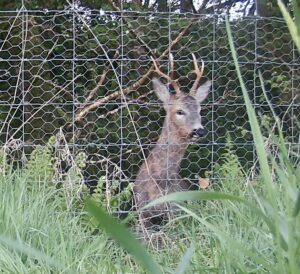
My husband and I bought Lighthouse Meadow in 2022 from woodlands.co.uk.   I’d always wanted to plant my own woodland and see the wildlife changes as the land evolved from grazed grassland to biodiverse woodland.  Our preference was to avoid using plastic tree guards due to the environmental waste. The site is also windy so we wanted to encourage wind-induced root development to have stronger, more wind resistant trees: tree guards can limit strong root development, resulting in weak, top-heavy trees which are more prone to damage in strong winds. The protect the young trees from predation by deer and rabbits, we installed a deer fence with rabbit mesh. Featured image is a male fallow deer peering through our fence wishing he could eat one of my hazel saplings.  We used mulch mats around the base of each young tree, held down with five bamboo pegs. Over two years we have planted 3000 trees using this method. I won’t lie, it is hard work! We used mulch mats made from jute, a 100% biodegradable natural fibre. Their purpose is to suppress the growth of grass around the young tree. They are permeable, allowing air, nutrients and water to pass through them which also helps in reducing moisture loss. In the above photo, Tim has secured a mulch mat around a hazel sapling using a bamboo peg at each corner and a fifth peg to fix the flap of the mulch mat in place. NB : we found that a rubber mallet was kinder on knuckles than a metal one! We are now 18 months on from planting our first trees so I’ve had a chance to assess how well the mulch mats have performed. Last year (2024) had a wet summer and the grass grew very tall. We found that many of the mulch mats had started to biodegrade around the one year point. Our field is steeply sloping which meant that tall grass at the top end of the mulch mats tended to flop over, swamping the shorter saplings like wild plum and oak. So we needed to do quite a bit of maintenance, uncovering some of the trees and trimming the grass. The mulch mats had worked very effectively to suppress the grass immediately around the sapling. The  photo below shows a hornbeam sapling we planted 18 months ago. I’ve pulled back the grass which had flopped over. Although the mulch mat has completely biodegraded, you can still clearly see the square shape where it once was and the grass growth immediately around the sapling continues to be suppressed. The tree is healthy and now tall enough to be above the grass. We planted our second lot of trees in November 2024. However, we have had to reaffix and replace some of the mulch mats we used then because they were damaged during Storm Darragh. We found that the extra strong storm winds were able to rip up some of the mulch mats, despite being pegged down with five bamboo pegs. However, we weren’t the only ones needing to do some maintenance following the storm. Our neighbour has been planting trees using tall plastic tree guards and stakes. His trees also suffered during the storm and he had to re-stake and re-affix many tree guards. So although we found ourselves doing a fair bit of extra work to reattach the mulch mats, other tree protection methods had also suffered and required maintenance. The above photo of a young oak we planted Autumn 2024 shows how the strong Storm Darragh winds have torn up the mulch mat. So, would I use mulch mats again in future? Yes, because after 18 months I can see that the impact of using mulch mats is still benefitting the trees, despite the mulch mat having degraded. However, we have learnt a lot in the last year and we’ve bought a petrol mower (with a ‘drive’ function) and have regularly mowed strips across the field trimming the grass along the top end of the mulch mats to reduce the risk of tall grass flopping over the saplings. We have also learnt that our field has a very substantial population of field voles and the mulch mats don’t protect the saplings from voles gnawing the bark. We have lost around 5% of the trees to vole damage. Tree guards also wouldn’t protect a sapling as the voles can still easily get up inside the tree guards. We are therefore adopting a nature-based solution and will be erecting tall perches for birds of prey. We wish to encourage tawny and barn owls, buzzards and other raptors to the field to feed on the voles. For more information on our use of mulch mats, we made a film for WoodlandsTV, Plastic Free Tree Planting. We are also going to follow the recent WoodlandsTV film by Jack D’Gama and George Hassall on Birds of Prey Perches: one way to reduce rodent damage to young trees as inspiration for our owl and buzzard perches to manage the vole population.
Plastics and tree guards

Plastics and tree guards

by The blog at woodlands.co.uk, 27 October, 2023, 1 comments

Plastic is a problem, plastic is universal.  A class from Ramsbury Primary School went on a walk round their village, looking for signs of plastic pollution. When they looked in the hedgerows (lining the paths and fields), they found old plastic tree guards (and hedge guards).  Some were breaking up into pieces, some growing growing into the bark of the trees.  In addition, there were plastic bottles, face masks, dog poo bags, sweet wrappers, plastic ropes, plastic bags, and plastic wrappers from hay bales. Plastic  litters our world.  Each year, hundreds of million tonnes are produced. It is used but often it is not recycled - it is discarded.  It litters the land, rivers and oceans.  It is now almost impossible to walk in the countryside or on a beach without encountering plastic in one form or another.  Discarded plastic can kill or injure.  Mammals, reptiles, birds can be harmed through eating plastic or becoming entangled in it. Plastics are made up of repeating units (monomers) that join together to form long chains (polymers). There are six major polymer types, PET, HDPE, PVC, LDPE, PP and PS. Many are derived from petrochemicals.  Additives are incorporated into plastics and these can gradually leach back out either during normal use, or when in landfills, or following improper disposal in the environment.  Whilst plastics serve many different functions, their makeup means that they do not easily break down, they persist.  Consequently, a lot of plastic goes to landfill or it may be burnt (to generate energy) - which in turn can release greenhouse gases and pollutants.  Ideally plastics would be reused, like glass bottles were recycled in the dairy industry for over a century. Polyethylene is used widely for plastic bottles and food packaging, PVC is used to make pipes (for water / sewage), coating for electrical cables, uPVC windows and fascia boards. Recycled PVC can be used to make certain types of tree guards, for example :Spiral guards.  Such guards offer protection to young trees and hedgerow so that they can establish themselves, avoiding being chomped by rabbits, deer or sheep.  The guards also offer a micro-climate that helps growth. UV stabilised polyethylene is used to make netting / mesh to protect young trees. [caption id="attachment_34477" align="alignright" width="300"] Tree guards, to protect young trees on moorland[/caption] Tree failure can be an expensive process, so it is important to give young trees a ‘good start in life. A ‘weed’ free area around the planted tree reduces competition for water, light etc. In theory, it should be possible to reuse plastic guards, but they are often damaged, degraded or have to be cut to remove them from the young tree.  As they are not biodegradable, it is important that they are collected and removed. Ideally this material should be recycled.  If many trees are being planted, it may be simpler / more cost effective to fence off the planted area to protect young trees from browsing activity. Because of the problems associated with plastic tree guards, there are now a number of alternatives available.  For example, wool-based tree guards / shelters (eg. Next Gen) are fully biodegradable being made from wool A biodegradable polyol made from ethically sourced cashew nutshell liquid and castor oil A polymer that breaks down over time Other biodegradable forms of tree protection make use of a polymer made from sugar cane (eg. HyTex products).  Such guards decompose slowly through the action of microbes (bacteria and fungi), temperature and humidity, gradually forming a  compost - so their removal is not needed.