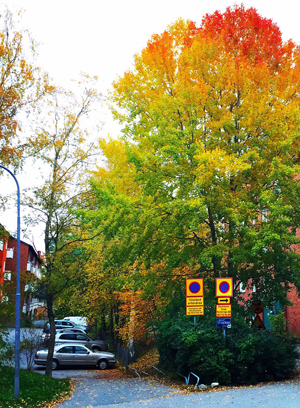
Urban forests.
by The blog at woodlands.co.uk, 10 May, 2023, 0 comments
According to the United Nations, a forest is anywhere that is at least 20% trees. As 21% of our capital city, London, lies under the canopy of trees - it is an urban forest*. It is estimated that there are some 8 million plus trees - nearly as many trees as people. London is not alone, Johannesburg is a densely wooded city with some 6 million trees, planted throughout the streets and private properties. Tree Cities of the World is a programme that recognises cities and towns committed to ensuring that their urban forests and trees are properly maintained and sustainably managed.
Urban environments can create difficult conditions for tree growth and development. The trees may be exposed to pollutants, high temperatures (heat island effect), drought and/or flooding, and challenging conditions for growth. . Whilst trees may be planted, their subsequent care / nurturing may be limited due to insufficient resources (money / care etc). There needs to be long term maintenance to sustain not just healthy trees but also to make sure that the trees do not damage pavements / roads etc (for example, through root penetration). Trees for Streets is a new national tree sponsorship scheme that some councils have partnered with, which gives local residents the chance to have a tree near them or in a local park. It is a project run by the charity Trees for Cities which aims to support local communities in revitalising forgotten spaces, planting trees and improving the local environment.
[caption id="attachment_39418" align="aligncenter" width="675"] Greenery in SE London. View towards St.Helier's hospital.[/caption]
In the past, London was a much smaller city surrounded by countryside and woodland, but there are still areas of ancient woodland within it. Some of this woodland remains such as the Great North Wood in South London (hence Norwood and Forest Hill). Other place names - Wood Green, Forest Gate, Nine Elms and Burnt Oak bear witness to the wooded landscape that was once prevalent across London. In fact, some 8% of London’s area is still woodland, and some of it is even defined as ancient woodland (e.g. Epping Forest).
[caption id="attachment_39421" align="aligncenter" width="675"] Dulwich Park[/caption]
There are also the many parks of London - Hyde Park, Regent’s Park, Richmond Park, Dulwich Park etc. Add to these the trees found in school fields, private gardens, squares (like Berkeley and Portman Squares), plus the trees that line so many streets (estimated at 900,000). Trees (like sycamore and buddleia) have also colonised areas of the built environment, like railway lines / cuttings. The most common London trees are sycamore (7.8%), oaks (7.3%) and birch (6.2%). However, the urban forest has a wide spectrum of species that includes native species, such as
ash,
hawthorn,
hornbeam,
field maple and
holly,
but there is a wide variety of exotics and cultivars in parks, streets and private gardens.
In some parts of the capital, the London Plane is a noticeable presence, due to its resistance to pollution and tolerance of root compaction. It sheds 'large flakes' or sections of its bark exposing new material of a variety of colours (brown, grey, yellow), and is sometimes described as ‘self cleaning’. The London Plane is thought to be a hybrid of the American sycamore and Oriental plane.
So the urban forest is quite diverse in terms of species when viewed across the capital, but there are parts of the city where species diversity is poor and the age profile of the trees is sometimes limited. This homogeneity can favour pests and disease. Diversity generally favours to resilience. Currently, trees face diseases such as acute oak decline, Chalara ash dieback, horse chestnut leaf miner, Massaria disease of plane and oak processionary moth.
London’s urban forest faces an increasing human population and the challenges of climate change. The latter may bring substantial warming and changing rainfall patterns. Wetter, milder winters and drier, hotter summers may be more common in the coming decades. Some trees will be better able to cope with these changing conditions. Future planting will have to follow the maxim of “right tree, right place”.
The value of London’s forest is difficult to quantify or to put a figure on. It is a major part of the ‘green infrastructure’ – that is the matrix of green spaces, parks, recreation grounds, lakes, canals, and rivers plus the street trees , green roofs and allotments that provides a range of economic, environmental, and social benefits. The importance of green, leafy spaces came to the fore during the early days of the Covid pandemic, helping with mental and physical wellbeing of Londoners.
[caption id="attachment_27166" align="alignleft" width="300"] Mature oak in park.[/caption]
The components of the forest offer valuable habitats for wildlife and also provide biological corridors / stepping stones that enable birds and various animals to move through the urban environment. The ancient woodlands and veteran trees offer a home to a variety of wildlife such as bats, stag beetles, orchids etc. In recent heatwaves, people have appreciated that trees also provide shade and cooling in streets and parks.
Another aspect of extreme weather is very heavy rainfall, trees and green areas can help reduce the risk of flooding, allowing more water to enter the soil rather than running off hard surfaces of tarmac and concrete.
Trees also help capture pollutants, improving local air quality by capturing fine particles from the air (much of this is through deposition on leaf surfaces). One source suggest that trees remove some 2241 tonnes of pollutants each year. Trees and shrubs seem particularly effective in removing ozone, and through its photosynthetic capacity the urban forest can take up carbon dioxide into organic form. The amount of carbon taken up by London’s urban forest each year has been estimated at 77,200 tonnes.
To maintain and augment this urban forest, it is important in the coming years that
the threats of pests and diseases are fully assessed and controlled
The threats arising from climate change are recognised / mitigated
Woodlands are properly managed (eg. coppicing); this may include the training of personnel.
Create opportunities for planting of trees, hedgerows and woodland.
[caption id="attachment_39422" align="aligncenter" width="675"] Tree nursery - 'ready for planting'.[/caption]
* https://cdn.forestresearch.gov.uk/2022/04/21_0024_Leaflet-CC-factsheet-Urban-forests_wip06_Acc.pdf