Woodlands.co.uk

Blog - veins

A leaf challenge.

A leaf challenge.

by The blog at woodlands.co.uk, 18 April, 2025, 0 comments

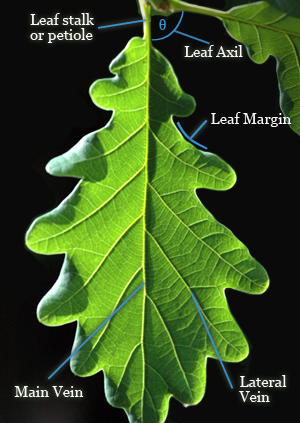
Leaves have three main parts:  The petiole, a stalk-like structure that connects the blade of the leaf to the stem of the plant. Some leaves don’t have petioles,  and are known as sessile leaves. The blade or lamina, usually the largest part of the leaf.  The edge of the leaf or the leaf margin may be described as entire, toothed, or lobed. The oak leaf, for example, is clearly lobed. The blade has many veins, forming a network, carrying water and nutrients, The base, the base is the region of the blade that attaches to the petiole. A leaf is said to be simple if its blade / lamina is undivided, if the ‘teeth’ or lobes do not reach down to the main vein of the leaf.  A compound leaf has several leaflets, which join up with a single leaf stalk or petiole. When identifying tree leaves, it is always important to look for the petiole,   as a single leaflet of a compound leaf can look like a simple leaf.  More details of leaf and tree structure can be found on this link on our website. Now for a challenge.  Can you or your children find a leaf (and name the tree it came from), that Has a serrated / toothed edge Has a lobed margin Has a smooth edge / margin Is a compound, palmate leaf Is a compound, pinnate leaf Is hairy Is not green, but red or a mixture of colours Is more or less circular Is fleshy / succulent Has spines on its edges Is needle shaped Has a thick (waxy?) cuticle or is very shiny Has net venation  is marcescent (might keep you hanging around) Go forage!
A sense of touch in plants.

A sense of touch in plants.

by The blog at woodlands.co.uk, 6 October, 2023, 0 comments

Climbing plants like sweet peas can ‘feel’ their way around a support, a twig or fencing. Charles Darwin, who had an interest in climbing plants, described Clematis as a leaf climber.  Clematis has compound leaves with three to five leaflets,  It uses the stalks of the leaves or the leaflets to climb. Darwin noted that contact with another structure was enough for the leaf stalk / petiole to start bending around it.  This ability to respond to touch is termed thigmotropism.  It is a growth response.   The growth rate on the side of the stem that touches the 'support' is slower than on the side opposite the point of touch.  As a result the stem begins to curl around the support.  The same response is seen in plants that climb using tendrils, such as White Bryony.  Its tendrils are thin, wiry structures along the stem that ‘reach out’ into the space around a plant until they come into contact with something they can ‘grab’.  Once contact is made, the tendril curls, forming a coil. This sense of ‘touch’ has recently been investigated using Thale or Mouse Ear Cress.  It has been shown that the veins of the leaves respond to touch.  The investigators used small glass beads to apply a small but distinct pressure, and recorded a series of rapid electrical signals (not dissimilar to those seen in nerves).  Even when the veins were removed from the surrounding leaf tissue, they still showed electrical activity so the response was not reliant on surrounding cells.  The electrical activity was also associated with proton pumps (moving hydrogen ions).  The sensitivity of the veins to touch may be associated with the plant’s defence mechanism.  Animals like aphids use their mouthparts (stylets) to penetrate the vascular tissue in the veins.  The jasmonate system is involved in wound response. Another plant, the Venus fly trap (Dionaea muscipula), also responds to touch. It catches prey (insects and spiders) by means of touch.   Dionaea catches its prey with a trap, formed from the terminal portion of each of the plant's leaves.  The trap is activated by tiny hairs on the inner surfaces of the trap. When a hair is touched by an insect or spider crawling along the leaves, the trap prepares to close but it only snaps shut  if the hairs are touched again, within approximately twenty seconds of the first stimulus.
