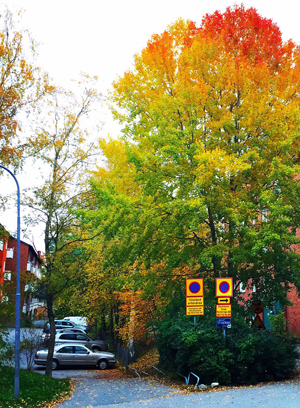
The short lives of many urban trees
by The blog at woodlands.co.uk, 3 November, 2023, 0 comments
The woodlands blog has reported on urban forests, the trees in our cities, lining our roads and in our gardens. This green infra-structure in our towns and cities provides a range of economic, environmental, and social benefits. The importance of green, leafy spaces was emphasised during the early days of the Covid pandemic, helping with mental and physical wellbeing of many people.
Urban trees offer
Valuable habitats for wildlife and can provide biological corridors / stepping stones that enable birds and other animals to move through the urban environment.
Shade and cooling in streets and parks.
They can help reduce the risk of flooding, allowing more water to enter the soil rather than running off hard surfaces of tarmac and concrete.
The capture of pollutants, improving local air quality by capturing fine particles from the air (mainly through deposition on leaf surfaces). Trees and shrubs seem particularly effective in removing ozone.
Through their photosynthetic capacity, trees can take up carbon dioxide into organic form - carbon sequestration. The amount of carbon taken up by London’s urban forest each year has been estimated at 77,200 tonnes.
However, recent studies suggest that many urban trees are under threat :
Trees are subject to heat stress as many cities experience the heat island effect, the ambient urban temperature is significantly above the surrounding countryside.
Many struggle to get sufficient water as they are planted in small square of soil and surrounded by tarmac, concrete or paving stones.
Soil compaction is often an issue, affecting water permeability.
They may experience an ‘excess of nutrients’ - due to dog’s urine, this is a source of urea and other nitrogen compounds.
Once planted, young trees may not receive after-care / management. This point is significant. Many trees die within the first few years of planting. In Boston (USA), some 40% of trees are dead within seven years of planting. Similar figures are true for New York.
Both rural and urban trees suffer significant mortality when young but whereas the death rate of rural trees tend to decrease after a few years - urban trees are more likely to die as they age.
[caption id="attachment_40541" align="alignleft" width="300"] Young urban tree[/caption]
There is a struggle to reach maturity. Most trees need two or three decades to offset the carbon emissions associated with their planting / maintenance etc, and they then sequester carbon at a significant rate. Work at Boston University (in Professor Lucy Hutyra’s lab) and Harvard has focused on the problems that urban trees are facing, and another issue (apart from those mentioned above) has been identified - the microbiome of the root [that is the variety of micro-organisms that surround / inhabit the root tissues]. Urban trees seem to have fewer symbiotic fungi in their root systems when compared to rural trees. Roots often develop mycorrhizal associations with fungi. Such systems allow the roots to access more water / minerals and in return the tree ‘offers’ the fungal network a supply of carbohydrates.
Jenny Bhatnagar (Harvard) has investigated the soil microbiome in eight different plots, some urban and some rural in Massachusetts. Interestingly, the investigation found that whilst there were more fungi in urban plots, they ‘seemed more reluctant’ to establish symbiotic associations with the roots of the trees. This failure could be due to the excess nitrogen / nitrates in the soil (from animal urine / faeces?). When there is an excess of nitrogen available, trees tend to dispense with their fungal partners. The hotter temperature of urban soils might 'favour' a bacterial population (some bacteria ‘fix’ nitrogen).
[caption id="attachment_40526" align="alignright" width="300"] Once, there was a cherry tree ...[/caption]
It is not clear as yet why so many urban trees fail. It could be that the loss of the symbiotic fungi renders the trees more susceptible to certain disease-causing microbes. The hotter and drier soils at the edges of fragmented forests have more pathogens and not so many symbiotic fungi.
A number of simple aftercare / management measures would help young trees to establish :
Watering the trees in their early years
Preventing soil compaction to allow water to percolate, and oxygen to diffuse to the roots.
Mulching around the tree base (helps water availability and slows nutrient input from urine etc.)
An interesting article on mycorrhizae and urban trees may be found here.
[caption id="attachment_40537" align="alignleft" width="220"] Olive[/caption]
The importance of soil micro-organisms is also indicated by research in Australia, where shrublands / woodlands have been invaded by African olive trees. The olives have disrupted the partnerships between the Acacia trees (hickory wattle) and symbiotic soil bacteria (Rhizobia ssp). This is another symbiotic association, where the partners exchange materials for mutual benefit, Where the Olives have grown, the Acacia have problems establishing root nodules with the bacteria. To restore these scrublands, a full understanding of the soil / root microbiome will be important.
Full details of this work can be found here.
Postscript :
In today’s Guardian (03/11/2023), Helena Horton’s article “Ministers should target tree survival ‘rather than planting’” reinforces the points made in the blog about the early mortality of young trees - urban or rural. Increasing woodland cover will only occur if young saplings survive.