Woodlands.co.uk

Blog - yew

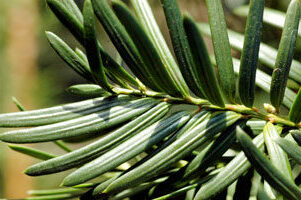
Yew leaves arranged in rows

The yew, a native conifer.

by The blog at woodlands.co.uk, 17 June, 2026, 0 comments

The yew is one of our native conifers, the others are the Scots Pine and Juniper.  The yew is exceptional in terms of its longevity.  The life span of the tree may run into the thousands of years, but more typically a tree may live for 1500 years.  Somewhat unusual features of the Yew are that   it is dioecious. That is, there are separate male and female trees.  This promotes cross fertilisation, increasing genetic diversity. when it sets seed, they are not in the typical conifer cone. They form in a fleshy red aril - a berry-like structure The yew is a medium sized conifer, that may reach a height of some 20 metres.  It has dark green needle-like leaves, which are somewhat flattened (see image).  The bark has a red / brown colour, which has an increasingly flaky appearance as the tree ages.  Again as the trees mature they may develop hollow trunks and splinter apart to form multiple stems.  This seems to be a regenerative strategy. This is particularly apparent in the Fortingall Yew, which is indeed is a very ancient tree, possibly the same age as Stonehenge! [caption id="attachment_43351" align="aligncenter" width="700"] Yew in a woodland setting[/caption] The Yew is distributed across the UK but is found more often in Southern and Central England, where it is associated with well drained soils seated on chalk and limestone.  It is also to be found in managed situations, ranging from church yards, large estates and parklands, to hedgerows in urban gardens.  In some places, the trees are managed to form topiary.     Yew trees can thrive in woodlands settings, though its dense evergreen canopy can create deep shade at ground level.  As the light intensity is reduced, this can reduce the diversity of the ground flora.  However, the trees offers shelter in the winter months to various birds (such as the Chaffinch, Robin, and Wren) and mammals.  Most of the tree is toxic, the only edible part is the red aril that surrounds the seeds.   The seeds contain high concentrations of taxine alkaloids, which if ingested interfere with the electrical signals in the heart.  In recent years, yew trees have been planted in large numbers in China to provide material for the extraction of one of its toxic chemicals for the anti-cancer drug taxol/paclitaxel. This drug acts by interfering with the division of cancer cells.  However, some birds can eat the aril and the seed, the seed then passes through the gut undigested.  This aids the dispersal of the seeds over a significant area  The toxicity of the tree is important in that it protects against grazing by deer etc.  Yew wood is noted for its red/brown colour and its durability.  In the past, it was greatly valued in the making of long bows due to its flexibility and strength.  The rich colour and grain of the wood mean that is used to make veneers and in furniture making.  As the wood is hard and dense, it is favoured by woodturners to create bowls and lamp bases.  The wood is also used in the making of violins and other musical instruments.  Yew wood is remarkably resistant to decay / rot, which makes it particularly suitable for outdoor furniture.  However, as the tree is slowing growing and often ‘twisted’ and/or knotted, it is difficult to obtain large planks of the wood in any quantity. For many centuries, Yew has been associated with churchyards and this is where many ancient yews are to be found.  In a Christian context, the yew represents eternal life and resurrection. Its evergreen nature being symbolic of eternal life. Some yews may predate the building of the churches, pagan tradition associated the tree with winter festivals and the cycle of life.  Further details of the association of Yew with religion and folklore, see https://www.whitedragon.org.uk/articles/yew.htm
Britain’s Ancient Wildwood

Britain’s Ancient Wildwood

by Anton, 1 May, 2026, 0 comments

How Trees Reclaimed a Frozen Land The British landscape we know today, its rolling hills, hedgerows and scattered woodlands, is the product of thousands of years of change. But rewind far enough and none of it existed. After the last Ice Age, Britain was a treeless, frozen expanse. What followed was one of the most remarkable transformations in the natural history of these islands: the slow, steady return of the forests. A land emerging from ice About fifteen thousand years ago, the climate began to warm and the ice sheets that had smothered much of Britain started retreating northward. The southern parts of the country may have supported a sparse arctic grassland, but trees were entirely absent.  Sea levels remained low, vast quantities of water were still locked up in ice, so Britain was physically connected to mainland Europe. A broad plain of meandering rivers linked present-day East Anglia with the Netherlands and northern Germany, across a region now submerged beneath the North Sea and often referred to as Doggerland. This land bridge allowed plants, animals, and eventually human settlers to make their way into Britain from the continent, setting in motion changes that would reshape the landscape dramatically. The pioneer trees arrive Trees gradually colonised the bare ground. The first wooded areas were likely dominated by birch — species such as Betula nana and B. pubescens that tolerate extreme cold. Although the climate was warming, conditions were still too harsh for many pollinating insects. Birch is wind-pollinated, making it an ideal pioneer species: one that can establish itself on immature or disturbed soils in challenging environments. In doing so, pioneer species modify their surroundings and 'open the door' for others to follow, a process known as succession. Over time, pine, aspen and hazel arrived and took hold, followed later by elm, oak and small-leaved lime. Forests spread across Britain, covering the land except for the highest, wettest and coldest areas. Reading the past through pollen How do we know what grew where, and when? Pollen analysis of peat bogs and other sedimentary deposits can reveal which species were present over different periods. The outer wall of a pollen grain — the exine — is extraordinarily resistant to decay, so its distinctive structure remains intact for millennia, allowing researchers to identify species long after the trees themselves have vanished. The wildwood takes shape By around six thousand years ago, forest covered most of the British countryside. This great expanse of woodland is often called the “wildwood”, a term popularised by Oliver Rackham in Trees and Woodlands in the British Landscape. The wildwood was at its most abundant during this period: a complex, tangled mosaic of trees, many of them dead or dying from the effects of wind, fire sparked by lightning, and flooding. It would have offered a rich variety of habitats and niches for plants, insects and mammals alike. Not as dense as you might think Recent research and pollen analysis published in the Journal of Ecology suggests that Europe’s post-glacial wildwoods were rich in hazel, oak and yew; species that tend to flourish in more open woodland where light reaches the ground, rather than in dense, closed-canopy forest. Hazel produces more pollen and flowers freely in sunlit conditions. Yew, while sensitive to fire, is shade-tolerant and needs some space and light to avoid being outcompeted by taller trees. Its leaves are toxic to most mammals (including humans), which protects it from grazing. The persistence of yew in ancient woodlands, along with its sensitivity to fire, points to a relatively open woodland structure; one maintained, it is thought, by the grazing activity of large herbivores. Oak, too, is a light-demanding species whose seeds germinate best on disturbed ground. Large herbivores consume huge quantities of vegetation, altering plant biomass and community composition. They also cause physical damage through trampling and bark-stripping. These processes can help create clearings and maintain open areas within the woodland. The resulting light reaching the forest floor would have encouraged a rich ground flora to flourish beneath the canopy. A living legacy Britain’s wildwood may be largely gone, but its legacy runs through the landscape. The oaks, hazels and yews that define many of our oldest woodlands are living links to those post-glacial forests. Understanding how they established themselves and how grazing, fire and climate shaped the woodland around them isn’t just a matter of historical curiosity. It offers practical insight for anyone involved in woodland conservation and restoration today. The wildwood reminds us that British forests were never static or uniform; they were dynamic, open and shaped  by many animals,  and the elements. 
immature pine cone

A variety of conifers (at Bedgebury Pinetum).

by The blog at woodlands.co.uk, 31 July, 2025, 0 comments

When thinking of conifers, one might feel a bit ‘schizophrenic’.  Perhaps picturing a Leylandii encroaching on your garden, whilst also remembering your Christmas tree.  Maybe the typical image of conifers is that of a tree with dark green foliage all year round.  However, this would be something of a disservice to the Conifer family - the Pinophyta, which contains an amazing variety of trees, many of which are at risk of extinction.  This group includes cedars, firs, cypresses, junipers, larches, pines, hemlocks, redwoods, spruces, and yews. [caption id="attachment_32107" align="aligncenter" width="650"] Leaves on the branchlets of Dawn Redwood[/caption] Conifers are important because They dominate vast areas of land, particularly in the Northern Hemisphere,  forming the boreal forests or taiga. Softwood from conifers accounts for approximately 45% of global timber production. Pine, spruce and larch are often grown specifically for softwood production. The wood is also used in the paper production[.and, to a lesser extent, in making plastic from chemically treated wood pulp].  Some species produce edible seeds , such as pine nuts provide foods such as pine nuts for humans and wildlife and juniper berries, which are used to flavour gin.  The Monkey Puzzle tree, (also known as the Pehuen Pine, native to Chile and Argentina) produces seeds known as piñones; traditionally harvested by indigenous communities.  [caption id="attachment_27592" align="aligncenter" width="600"] Monkey puzzle tree[/caption] To see the diversity of the Conifer family one could visit the Bedgebury Pinetum.  This is home to one of the world’s most important conifer collections.  Bedgebury was established in 1925 by Kew Gardens and the Forestry Commission.  The curator at Kew had observed that the conifers there were ‘being choked by London Smogs’.  The site at Bedgebury, situated on the Southern Kentish weald, was ideal.  It offered an escape from the pollution of London and it had wet and free draining areas, plus varied soils so it a range of conifer could be grown. The land already had some conifers that had been planted by Viscount Beresford - an evergreen enthusiast.  In 1925, some 315 trees were planted.  This year, to celebrate reaching a century, some 89 of the original trees are marked with special yellow labels.  For  its first twenty years, the pinetum was managed by William Dallimore. His diaries record in some detail the trees he planted, and the challenges faced in establishing the pinetumIf you visit, then you might walk through through Dallimore Valley, and view his legacy. Bedgebury soon became a centre for the scientific interest in conifers, their conservation, and landscape planning.  The current curator is Dan Luscombe. Apart from seeing a range of conifers, the pinetum offers a variety of activities, e.g. family cycling, mountain biking and walking, There is also the play trail or you can explore the canopy on a Go Ape tree-top adventure or challenge.  It is rumoured that the Gruffalow lurks within the grounds of the  Pinetum. There is also a cafe, serving a range of drinks, plus  breakfast and lunch options. The pinetum is open from from 8 AM to 8 PM (March 2025 to 26 October 2025), and there are charges for car parking.  
Forests in the Fens ?

Forests in the Fens ?

by Chris, 15 March, 2024, 1 comments

To see the forests of  The Fens,  you would need to be a time traveller, as they were ‘lost’ some four thousand years ago.  Today, The Fens are a low lying agricultural region that forms part of Norfolk, Lincolnshire and Cambridgeshire.    The Fens contain some of the best agricultural land in the U.K., growing potatoes, sugar beet, and wheat.  A naturally marshy area, it was drained centuries ago and is now maintained through a complex system of drainage canals, dykes and pumping stations.  As a result of the drainage, the level of the land in many places has shrunk.  Indeed, in places, the land level is below sea level.  There are occasional ‘hills’ or islands, which have remained dry even when the surrounding area has been flooded.  The city of Ely and its cathedral was built on such a clay island. Deeper ploughing (e.g. for potatoes) in this area has over the years exposed  ’bog oaks’, large logs between two and eight metres in length.  The trunks were sometimes piled up in so-called clearance  cairns on the edges of a field, or allowed to dry out and later used for fuel.  Recently, ‘oaks’ from a number of farms across the region have been examined by researchers at Cambridge University and many have been identified as the remains of ancient yew trees.  The various logs were often well preserved in the peaty soils of the area, and this allowed detailed analysis of the annual rings (dendrochronology). The rings showed that some of the Yews were 400 years old, when they died.  Tree ring analysis plus examination of the pollen grains* (found in the peat), suggests that the area had dense yew (and oak) woodlands some 4500 years ago.  However, these woods were lost about 4200 years before today, probably due to an abrupt rise in sea level.   The trees would have been unable to tolerate the salt water (nor salt spray) when the area around The Wash was inundated.  Quite what was responsible for the rise in sea level is not clear, though other significant climatic events in different parts of the world have been recorded at this time. the 'wall' of pollen grains  [the exine] is made from a chemical [sporopollenin] that is extremely resistant to decay / degradation, so the grains  retain their shape / markings for thousands of years;  this means that plant species can be identified [palynology].  

Next Page »
